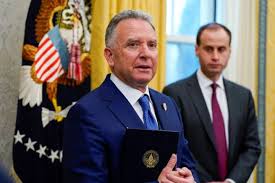



















On Friday, Cambodia accused Thailand of ongoing bombardment at the border, shortly after US President Donald Trump announced an agreement between both nations to resume the ceasefire. The accusations from Cambodia followed Trump’s conversation with Thai Prime Minister Anutin Charnvirakul and Cambodian Prime Minister Hun Manet.
“On December 13, 2025, the Thai military deployed two F-16 fighter jets to drop seven bombs on various targets,” stated the Cambodian Defence Ministry in a social media post on Saturday. “Thai forces have yet to cease the bombing and are persisting with their attacks,” the ministry added, detailing aerial assaults on hotel structures and bridges earlier that morning.
In the meantime, local news source Khmer Times reported, citing the Cambodian Ministry of Information, that two hotels were bombed in the Thmor Da region of Pursat province, which borders Thailand. The news outlet also shared a collection of images depicting severely damaged hotel and casino buildings.
Will Trump’s call be in vain?
The reports of these airstrikes emerged after Trump declared on his social media platform TruthSocial that Thailand and Cambodia had consented “to cease all shooting” on Friday. “I had a very productive discussion this morning with the Prime Minister of Thailand, Anutin Charnvirakul, and the Prime Minister of Cambodia, Hun Manet, regarding the regrettable resurgence of their long-standing conflict,” Trump mentioned in his post.
It is important to highlight that the initial ceasefire between the two nations was facilitated by Malaysia in July. This truce was also influenced by pressure from Trump, who threatened to revoke trade privileges unless Thailand and Cambodia reached an agreement. The arrangement was ultimately formalized in October during a regional meeting in Malaysia, which Trump attended.
Nevertheless, despite the agreement, both Thailand and Cambodia persisted in their contentious propaganda battle, and minor incidents of cross-border violence continued.
It is crucial to recognize that the origin of these conflicts is rooted in a historical animosity regarding conflicting territorial claims. These claims primarily originate from a map produced in 1907 during the period of French colonial governance in Cambodia, which Thailand argues is erroneous. The relationship between the two countries became increasingly strained in 1962 when the International Court of Justice’s decision granted sovereignty to Cambodia, a ruling that continues to provoke discontent among many Thais.