


















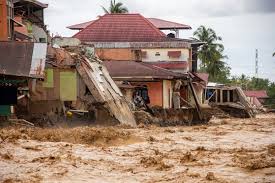
Officials in areas of Indonesia affected by flooding have reported a lack of food, shelter, and medical supplies, as the death toll reached 950 on Monday after weeks of persistent heavy rainfall.
A series of tropical storms and monsoon rains have battered Southeast and South Asia, causing landslides and flash floods from the rainforests of Indonesia’s western Sumatra island to the highland plantations of Sri Lanka.
“We are facing a severe shortage of resources, particularly medical staff. There is a deficiency of doctors,” stated Muzakir Manaf, the governor of Indonesia’s Aceh province, during a press briefing late Sunday.
“Basic necessities are crucial as well. It is not limited to just one or two items.”
According to Indonesia’s national disaster mitigation agency (BNPB), 950 individuals in Aceh, North Sumatra, and West Sumatra have lost their lives, with 274 still unaccounted for.
The heavy rains and resulting landslides have left at least 5,000 individuals injured and have caused significant damage to infrastructure.
Hospitals, schools, and government buildings are in ruins, and numerous bridges have been destroyed, isolating communities.
The cost of reconstruction following the disaster could reach up to 51.82 trillion rupiah ($3.1 billion), as reported by the BNPB late Sunday.
Additional troops
In Sri Lanka, the military has deployed thousands of additional troops to assist in recovery efforts following a catastrophic cyclone that resulted in the deaths of 627 individuals.
Over two million people – nearly 10 percent of the population – have been impacted by Cyclone Ditwah, which is the most severe cyclone to hit the island this century.
Sri Lanka is bracing for more heavy monsoon rains on Monday, with accumulations exceeding five centimeters in many regions, according to the Disaster Management Centre (DMC), which has issued alerts for potential further landslides.
Army chief Lasantha Rodrigo announced that 38,500 security personnel have been dispatched to enhance recovery and clean-up efforts in areas affected by floods and landslides, nearly doubling the initial number of deployed forces.
“Since the onset of the disaster, security forces have successfully rescued 31,116 individuals who were in peril,” Rodrigo mentioned in a statement.
President Anura Kumara Dissanayake announced a recovery initiative, providing 10 million rupees ($33,000) to assist victims in purchasing land in safer locations and rebuilding their lives.
Additionally, there is support for livelihoods and cash aid to replace kitchenware and bedding, as well as to purchase food.
The total cost of the relief package to the government remains uncertain, as it is still recovering from the economic crisis of 2022, during which it depleted its foreign exchange reserves necessary for even the most critical imports.
Dissanayake has indicated that the government cannot solely finance the reconstruction efforts and has requested foreign aid, including assistance from the International Monetary Fund.
In Banda Aceh, Indonesia, long lines have formed for access to drinking water and fuel, with an AFP correspondent reporting that the prices of essential goods, such as eggs, have surged dramatically.
Seasonal monsoon rains are a characteristic aspect of life in South Asia and Southeast Asia, inundating rice paddies and promoting the growth of other vital crops.
Nevertheless, climate change is rendering this phenomenon increasingly erratic, unpredictable, and hazardous across these regions.