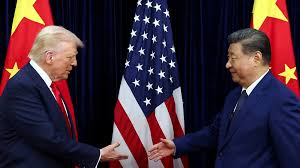

















On Wednesday, US President Donald Trump announced that his administration has granted South Korea permission to construct a nuclear-powered submarine. This significant declaration came just a day after he finalized an agreement that requires South Korea to invest an impressive $350 billion into the US economy.
These actions are part of a broader trade agreement that South Korea’s newly elected President Lee Jae Myung aimed to establish during a bilateral meeting with Trump on Wednesday. The president stated on Truth Social during his extended visit to South Korea, “Our Military Alliance is stronger than ever before and, based on that, I have given them approval to build a Nuclear Powered Submarine, rather than the old-fashioned, and far less nimble, diesel-powered Submarines that they have now.”
He noted that the submarine will be constructed in Philadelphia, as both the president and lawmakers are seeking foreign investments to enhance the American shipbuilding sector. It is noteworthy that a South Korean firm acquired the Philadelphia shipyard last year.
Why it matters
The significance of this move lies in the fact that the United States has historically shared nuclear propulsion technology only with the United Kingdom and, more recently, Australia, as part of the 2021 AUKUS agreement, which aims to assist Australia in developing a new class of nuclear-powered submarines.
For many years, America has kept this sensitive technology confidential. Nevertheless, the increasing threat posed by China’s military expansion in the Indo-Pacific region has prompted allies to seek more advanced weaponry from the United States.
It is also important to highlight that the shipyard mentioned by Trump in his post is not currently equipped to manage nuclear materials or construct military vessels, as it operates strictly as a commercial facility. Alex Wong, Hanwha’s chief strategy officer, stated, “As President Trump and President Lee make shipbuilding a central plank in the U.S.-Korea alliance, Hanwha stands ready to support with our advanced shipbuilding scale.”
“Through Hanwha Philly Shipyard and various investments and collaborations, a revitalized American shipbuilding industry will provide advantages to US workers, promote prosperity for both the United States and Korea, and strengthen the shared security of our nations,” Wong stated.
The agreement and the chosen construction site prompt inquiries regarding the duration required for the facility to be equipped for this type of highly specialized and sensitive work, which necessitates a trained and skilled workforce, as well as the total cost involved in completely renovating the facility.
It is important to highlight that Huntington Ingalls Industries, the American firm tasked with constructing nuclear-powered submarines, is already experiencing construction delays of two to three years for the Virginia-class nuclear submarines, and delays of 18 to 24 months for the first vessel in the new Columbia-class submarines, as reported by Politico. China has yet to provide a response to this issue.