

















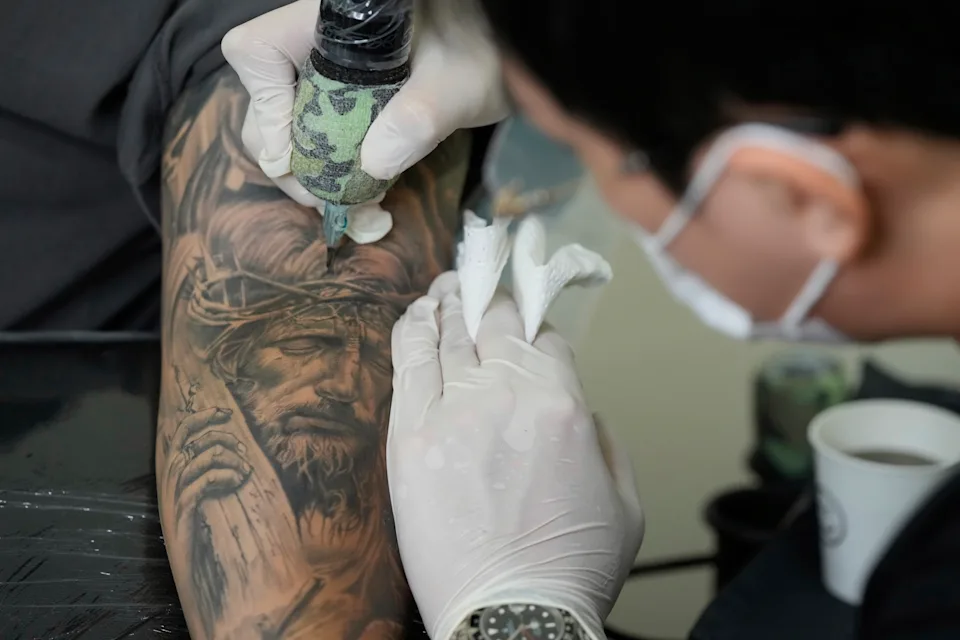
A new law is currently being developed that will bring South Korea’s tattoo culture and its related industry back into the mainstream.
In 1992, a ruling by the Supreme Court classified tattooing as a form of ‘medical’ work, prohibiting non-medical individuals from performing tattooing. This decision effectively pushed the tattooing industry in South Korea underground. However, a new piece of legislation, known as the Tattooist Act, has been passed by lawmakers, which may alter this situation.
According to the law, both tattoos and semi-permanent makeup are categorized as “tattooing acts,” allowing licensed professionals to engage in these practices without the requirement for medical professionals as mandated by the Supreme Court, as reported by Yonhap news agency.
Nonetheless, the new law will continue to prohibit tattoo removal by non-medical professionals and tattooing minors without parental consent.
Additionally, the law aims to resolve a longstanding irony in South Korea — while obtaining a tattoo was never illegal, it was effectively illegal to receive one since tattoo artists were required to be medical professionals.
The underground tattoo industry in South Korea has been thriving.
To clarify, the tattoo culture in South Korea has not diminished. Many individuals have continued to get tattoos, albeit in clandestine studios located in alleys or the basements of buildings. However, with President Lee Jae Myung expected to sign the bill into law in the coming days, these studios are poised to enter the mainstream.
“Now we can take pride in our profession and operate in spaces with large windows, similar to hair salons. We may need to renovate our studios and retrain our artists to comply with the necessary hygiene and safety standards, but it will be worthwhile,” stated Heo Jun-ho, who manages a tattoo parlor in Seoul, in an interview with The New York Times.
Despite the Supreme Court’s imposition of standards that effectively prohibited the tattooing industry, an estimated 350,000 tattoo artists were present in South Korea as of 2021, according to BBC News.
The majority of these artists focused on semi-permanent makeup for lips, eyebrows, or hairlines, with relatively few possessing any medical qualifications; instead, most hailed from artistic or beauty-related backgrounds, similar to trends observed globally, as reported.
Tattoos in South Korea have historically been a contentious issue, carrying significant stigma in contemporary society. Conservatives have associated tattoos with delinquency, and during the medieval period, individuals were often forcibly marked with tattoos on their faces or arms to denote their crimes or to brand them as slaves, as noted by The Times.
Nevertheless, in recent years, South Korean pop culture, particularly K-pop, has contributed to the normalization of tattoos to a certain degree, leading to a gradual increase in societal acceptance.