

















A tooth in your eye to assist with vision restoration? It may seem strange, even implausible, yet it is indeed a reality.
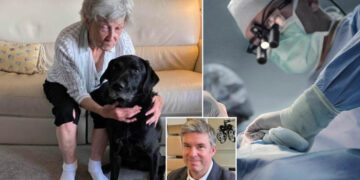
Gail Lane, a 75-year-old resident of Canada, lost her sight a decade ago due to an autoimmune condition that severely damaged her corneas. Today, she is able to perceive light and shapes once more, thanks to a groundbreaking surgical procedure.
The operation, known as osteo-odonto keratoprosthesis, or more commonly referred to as “tooth-in-eye surgery,” utilizes the patient’s own tooth to aid in the restoration of vision.
Here’s an explanation of how the procedure functions and why it is instilling hope in individuals who believed they would never regain their sight.
‘I can see lots of colours’
As reported by the New York Post, Gail Lane underwent this extraordinary procedure in February at Mount Saint Joseph Hospital in Vancouver. After a decade spent in darkness, she was finally able to see her partner’s face and the wagging tail of her cherished dog for the first time.
“I can see lots of colour, and I can see outside now,” the 75-year-old shared with CBC News. “The trees and the grass and flowers, it’s a wonderful feeling to be able to see some of those things again,” she continued.
In the weeks following the surgery, Lane’s vision gradually improved. Initially, she could only perceive light. Subsequently, she gained the ability to notice movement, including the familiar swish of her dog Piper’s tail. Six months later, she was able to recognize the face of her husband, Phil, whom she had met after losing her sight.
“I’m starting to see facial features on other people as well, which is also pretty exciting,” she remarked. Lane has not yet been able to view her own face clearly, but she remains hopeful that the new pair of glasses she is expecting soon will assist her.
How the procedure works
Although this surgery has been conducted in various locations around the globe, ophthalmologist Dr. Greg Moloney at Mount Saint Joseph Hospital was the first to introduce it to Canada.
“It’s a complex and unusual operation, but it fundamentally involves replacing the cornea,” Moloney explained to CBC News.
The procedure commences with the extraction of one of the patient’s teeth. This tooth is subsequently implanted into the patient’s cheek for a duration of several months, allowing it to be enveloped by robust connective tissue.
When the time is right, both the tooth and the surrounding tissue are extracted, and a small plastic focusing lens is placed within the tooth. The complete assembly is then sutured into the patient’s eye socket, utilizing the connective tissue as a natural support.
“We require a structure that possesses sufficient strength to secure the plastic focusing telescope, yet is unlikely to be rejected by the body,” Moloney articulated.
Lane characterized the surgical procedures and the recovery phase as uncomfortable, though not painful.
“It has been a lengthy wait, but ultimately, it has been well worth it,” she remarked.
A New Chapter
Lane shared with Global News that the loss of her vision had been profoundly distressing.
“It was heartbreaking. I reflected on all the things I could no longer see, and I wondered if I would ever regain that ability,” she expressed.
At present, she is eager to embrace greater independence.
“I aspire to achieve more mobility and autonomy regarding short excursions and strolls, where I do not always need to rely on someone’s arm for support,” Lane stated.
“I am genuinely looking forward to discovering what I can accomplish or revisit, and I am trying to be patient as my brain adapts, as that is another significant aspect of this process.”