

















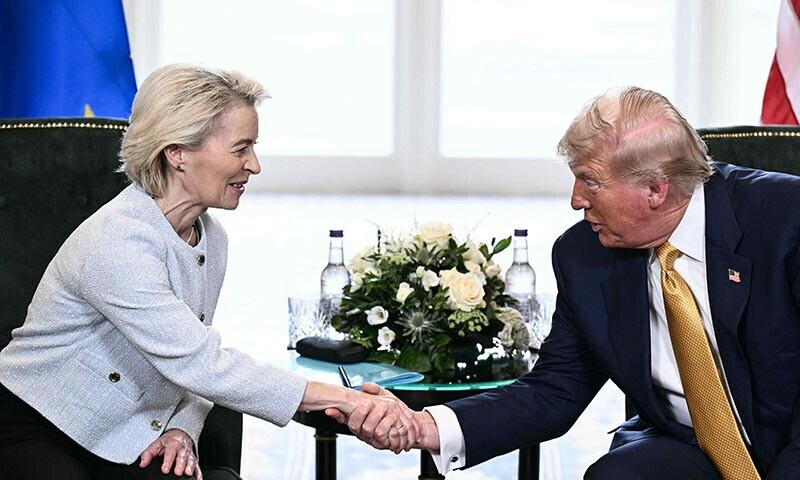
US President Donald Trump and European Commission President Ursula von der Leyen convened in Scotland on Sunday to advance critical trade negotiations, with both parties facing pressure to prevent a transatlantic tariff conflict ahead of the August 1 deadline.
These discussions follow weeks of intense negotiations between Washington and Brussels, as the EU aims to finalize a deal that would protect essential sectors, particularly automobiles, pharmaceuticals, and industrial goods from extensive new US tariffs.
Trump has warned of imposing additional 30% tariffs on EU products if an agreement is not achieved by Friday, in addition to existing tariffs of 25% on cars and parts and 50% on steel and aluminum. He has asserted that the EU has treated the US unjustly and cautioned that without a resolution, punitive actions would proceed.
Despite the escalating stakes, Trump indicated that the likelihood of reaching a deal was “50-50,” while referring to von der Leyen as a “highly respected woman” and expressing optimism that the meeting would yield positive results. Speaking from his Turnberry resort on Friday, he noted that there were “20 sticking points” in the negotiations but refrained from providing further details.
The EU, which is the largest trading partner of the United States, exported €532 billion ($603 billion) worth of goods to the US in 2024, with pharmaceuticals, auto components, and chemicals being among the most significant categories. Last year, the two parties exchanged a total of €1.6 trillion ($1.8 trillion) in goods and services, highlighting the importance of the negotiations.
In preparation for the discussions on Sunday, EU negotiators engaged with Japanese officials, whose recent agreement with Washington established a baseline tariff of 15%. Trump has been pursuing similar trade reforms globally, having already secured agreements with the UK, Japan, Indonesia, and Vietnam, although his administration has not fulfilled its commitment to “90 deals in 90 days.”
As time is of the essence, both Trump and von der Leyen are optimistic that the discussions taking place on Sunday in Scotland will facilitate an agreement capable of transforming one of the globe’s most significant trade relationships and preventing another economic conflict.