

















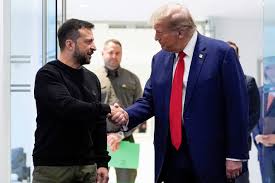
Ukrainian President Zelenskyy characterized his meeting with President Trump on Wednesday as “lengthy and meaningful,” with President Trump suggesting that he would contemplate providing Ukraine with additional Patriot air-defense missiles.
Ukrainian President Volodymyr Zelenskyy characterized his meeting with US President Donald Trump on Wednesday as “lengthy and meaningful,” emphasizing that the two leaders addressed initiatives aimed at achieving a ceasefire in Russia’s conflict with Ukraine.
Zelenskyy aimed to utilize a 50-minute discussion on the margins of the NATO summit in The Hague to advocate for investment in Ukraine’s defense efforts against Russia.
“We addressed all the genuinely significant matters. I express my gratitude to Mr. President, and I thank the United States,” he posted on X.
“We deliberated on how to attain a ceasefire and establish genuine peace.
“We conversed about measures to safeguard our citizens.”
Shortly after the meeting, President Trump suggested he would contemplate supplying Ukraine with additional Patriot air-defense missiles, which Kyiv depends on to protect itself from increasing Russian assaults.
During a press conference, Trump remarked that the weapons are “extremely difficult to procure” but stated, “we will explore the possibility of making some of them accessible.”
The US leader also left the door open for providing further military assistance to Kyiv, which has faced challenges in repelling relentless Russian advances on the battlefield in recent months.
Russia’s invasion, which began in February 2022, is approaching its three-and-a-half-year milestone, and Trump has not indicated any intention to resume the flow of weaponry that his predecessor Joe Biden had initiated.
Earlier at the summit, NATO leaders officially pledged to allocate 5% of their annual GDP towards defense and security-related expenditures by 2035, as stated in the final text of the Hague summit declaration that was just adopted.
The declaration also reaffirms ongoing support for Ukraine, highlighting that “Ukraine’s security is integral to our own.”
While it refrains from explicitly condemning Russia, it does include a distinct reference to “the enduring threat posed by Russia to Euro-Atlantic security.”
With contributions from various agencies.