

















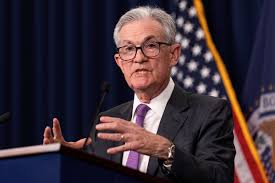
Powell is confronted with two days of potentially intense questioning on Capitol Hill, as Trump has consistently urged the Federal Reserve to lower borrowing costs.
The Federal Reserve will maintain its current position and observe the evolution of the economy before making a decision on whether to lower its key interest rate, stated Chair Jerome Powell on Tuesday, a position that directly contradicts President Donald Trump’s demands for immediate reductions.
“At this moment, we are adequately positioned to wait and gather more information regarding the probable trajectory of the economy before contemplating any modifications to our policy stance,” Powell remarked in prepared statements he will present on Tuesday to the House Financial Services Committee.
Powell is anticipated to face two days of potentially rigorous questioning on Capitol Hill, as Trump has consistently urged the Fed to lower borrowing costs. Historically, Powell has received a favorable response from House and Senate committees that oversee the Fed, or at least faced limited criticism. He has frequently pointed to his backing in Congress as a defense against Trump’s criticisms, although that support may diminish in light of the president’s ongoing attacks.
Trump expressed his frustration once more early Tuesday, posting on his social media platform: “I hope Congress truly holds this very foolish, obstinate individual accountable. We will be suffering the consequences of his incompetence for many years ahead.”
During Powell’s last appearance before Congress in February, Rep. French Hill, the Republican from Arkansas who chairs the financial services committee, urged Powell to ensure that inflation returns to the Fed’s target of 2%, which generally necessitates maintaining higher rates.
In his written testimony, Powell indicated that “increases in tariffs this year are likely to elevate prices and hinder economic activity.”
He noted that the inflationary impact from tariffs could be temporary, or it might result in a more sustained period of inflation.
The Fed’s “responsibility,” Powell stated, “is … to avert a one-time increase in the price level from evolving into a persistent inflation issue.”
The Federal Reserve’s 19-member committee responsible for setting interest rates, under the leadership of the chair, determines whether to increase or decrease borrowing costs. Typically, they raise rates to temper the economy in order to combat or avert inflation, and lower rates when the economy is sluggish to encourage borrowing and spending.
Last week, the Fed’s committee reached a unanimous decision to maintain its key interest rate, although they also published forecasts for potential future rate cuts that indicated growing divisions among the policymakers. Seven members anticipated no rate cuts this year, two expected just one cut, while ten predicted at least two reductions.
During a news conference last week, Powell indicated that the Fed would observe the economic developments over the summer in light of Trump’s tariffs and other policies before making a decision on rate cuts. His remarks implied that a reduction in rates would not take place until September.
However, two prominent members of the Fed’s governing board, Michelle Bowman and Christopher Waller, have since indicated that the central bank might lower its rate as soon as its next meeting in July. Both officials were appointed by Trump during his first term, and Waller is frequently mentioned as a possible successor to Powell when his term concludes next May. Powell himself was appointed by Trump in late 2017.
Trump is advocating for the Fed to reduce rates to alleviate the U.S. government’s interest payments associated with the substantial national debt. Nevertheless, the Fed has consistently resisted factoring in the government’s financing costs when making interest rate decisions, opting instead to concentrate on the economy’s health and inflation.
In a television interview on Friday, Waller stated that reducing the government’s borrowing costs is “not our job” and emphasized that it is the responsibility of Congress and the White House to address the budget deficit.
Trump, on social media Tuesday, reiterated his assertion that the European Central Bank has reduced its key rate ten times, while the Federal Reserve has not made any cuts. In reality, over the past 12 months, the ECB has lowered its rate eight times, whereas the Fed has implemented three reductions, all occurring late last year.
The Fed’s reductions last year brought its rate down to approximately 4.3%. However, since that time, it has paused further cuts due to concerns that Trump’s tariffs might lead to increased inflation. The president has imposed a 10% tariff on all imports, in addition to a 30% levy on goods from China, 50% on steel and aluminum, and 25% on automobiles.
Despite widespread apprehensions among economists regarding the effects of tariffs, inflation has consistently decreased this year. According to government reports last week, the consumer price index increased by only 0.1% from April to May, indicating that price pressures remain subdued.
While prices for certain goods rose last month, the costs for many services, including airfares and hotel accommodations, declined, counterbalancing any effects from tariffs. In comparison to the previous year, prices increased by 2.4% in May, up from 2.3% in April.