

















In March of this year, President Donald Trump of the United States declared the introduction of the F-47, which is touted as the world’s first sixth-generation fighter jet. While many believed that the number was a tribute to Trump, the narrative is more complex than that.
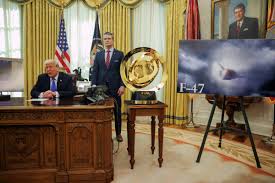
On March 21, 2025, US President Donald Trump declared from the Oval Office that he had instructed the American Air Force to proceed with the creation of “the world’s first sixth-generation fighter jet.” He was accompanied by US Secretary of Defence Pete Hegseth, who proceeded to extol the fighter jet’s “speed, manoeuvrability and payload.”
Hegseth remarked that the fighter jet is expected to be something “the likes of which nobody has seen before.” Trump then interjected his defence secretary, highlighting the name “F-47” for the fighter jet. “Nothing in the world comes even close to it,” Trump stated. “It’ll be known as the F-47. The generals selected the title. It’s a beautiful number.”
The revelation of the fighter jet’s name was unexpected, as it was anticipated to replace the F-22 aircraft. Many began to speculate whether the fighter jet was designated F-47 to pay tribute to the 47th President of the United States, Donald J Trump. While this assessment may hold some truth, there is more to the narrative. To comprehend the rationale behind the selection of the number 47 for the new series of fighter jets, we must first examine how the United States designates its weapon systems and aircraft.
How are names assigned?
It is important to highlight that the US military adheres to a long-established naming protocol for its aircraft. The guidelines are governed by a system known as the “Mission Design Series,” which was instituted by the Defence Department in the 1960s. “This system employs letters and numbers to represent identifying characteristics of military aerospace vehicles of direct interest to the DoD,” an Air Force memo acquired by Bloomberg stated.
The initial letter indicates the primary mission of the aircraft. For instance, the letter ‘B’ signifies that it is a bomber, while the letter ‘P’ indicates that it is intended for patrolling. Following this, there is a dash, succeeded by a number referred to as the ‘design number’.
According to an article published by the US Naval Institute, this figure indicates that the “aircraft represents a distinct design of that specific type or fundamental mission.” The number typically adheres to a sequential format. Nevertheless, the article emphasized that “there are numerous gaps and various exceptions to these sequences.” Since the F-47 is intended to succeed the F-22, this fighter jet would indeed fall into the category of exceptions.
Honouring history or Trump
When a journalist from Bloomberg submitted a Freedom of Information Act request to the US Air Force, he uncovered the true rationale behind the aircraft’s designation. The documents from the Air Force revealed that the name F-47 is derived from a legendary World War II fighter plane, and the generals considered it an intriguing method to pay tribute to the current US President.
The records indicated that General David Allvin, the chief of staff of the Air Force, had an “urgent” inquiry regarding a World War II aircraft. A few hours later, Air Force researchers provided a two-page overview of the P-47 aircraft, commonly referred to as the “Thunderbolt.”
Airmen adopted the nickname for the P-47, referring to it as the “Juggernaut.” Over time, as the jet resembled a glass milk bottle, it became known simply as the “Jug.” In the memo acquired by Bloomberg, the US Air Force characterized the P-47 as “arguably the finest ground-attack aircraft deployed by the United States. From D-Day, the European invasion that commenced on June 8, 1944, until VE Day on May 7, 1945, pilots operating the Thunderbolt obliterated the following enemy assets: 86,000 railway cars, 9,000 locomotives, 6,000 armored fighting vehicles, and 68,000 trucks.”
How the Air Force was left by surprise by Trump’s announcement
When Trump declared the introduction of the F-47 jet, neither he nor Hegseth acknowledged the legacy of the P-47. Bloomberg’s analysis suggested that the Air Force may have been taken by surprise or simply unprepared when the president announced the new fighter.
It is important to highlight that Trump’s press conference occurred at approximately 11:30 am (local time).
The email acquired by the news organization indicated that it was sent shortly after the press conference.
“Sir, please coordinate with the SECDEF office,” an Air Force public affairs official wrote in an email directed to Lieutenant General Dale White, the military deputy in the Air Force’s Office of the Assistant Secretary for Acquisition, Technology, and Logistics.
Nevertheless, General Allvin’s team refuted the assertion that the decision to honor the P-47 was made following Trump’s announcement.
At least one journalist pressed an Air Force spokesperson for further information regarding the “designation for the F-47.”
“The nomenclature system is designed to ensure an organized, non-chaotic process for naming systems,” the reporter inquired.
“Why was it disregarded in this instance? And who made that decision?” the reporter continued to ask.
Ann Stefanek, the Air Force spokesperson, did not provide any additional information on the subject and simply stated: “General Allvin made the decision.”
It will now remain uncertain precisely when the decision to honor the aircraft was made.