















Pope Francis, recognized for his transformative impact on the Catholic Church, passed away on Easter Monday. As the nine-day mourning period commences, discussions and speculation arise regarding his potential successor. Various candidates have emerged in the conversation. Following the election of the first Latin American Pope, will the next pontiff be the first of Black or Asian descent?
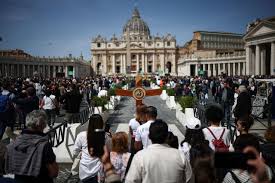
Pope Francis passed away on Easter Monday, April 21, at the age of 88. His death occurred just a day after he addressed thousands of worshippers in St. Peter’s Square, extending Easter greetings.
Last month, the Pope was released from a Roman hospital after undergoing five weeks of treatment for double pneumonia.
The pontiff’s passing initiates a nine-day mourning period, after which a new pope will be elected through a process rich in centuries-old tradition. It may take several weeks before the identity of the new leader of the Roman Catholic Church is revealed. However, various candidates have been speculated upon since the Pope’s hospitalization on February 14.
Who might take over from Francis as the next pope?
How is the new pope selected?
The election of the pope occurs at the Vatican during meetings known as the conclave. This private assembly is convened following the death of a pope or, in rare cases, a resignation, such as that of Pope Benedict XVI.
The papal conclave typically commences two to three weeks after the pontiff’s death or resignation. For instance, the conclave that elected Pope Francis began 12 days after Benedict XVI’s resignation.
Since 1379, the selection of the Pope has been conducted by the College of Cardinals, who cast their votes during the conclave. Out of 252 cardinals, 138 are eligible to vote, with only those under the age of 80 participating in the secret ballot held in the Sistine Chapel.
This process is shrouded in secrecy, and the public learns of the election outcome by observing the smoke from the Vatican’s rooftop. Black smoke signifies that no decision has been made, while white smoke indicates the election of a new Pope.
Who are the potential successors to Pope Francis?
In recent months, several names have emerged as possible successors to Pope Francis, with Cardinal Pietro Parolin being a prominent contender.
Cardinal Pietro Parolin: At 70 years old, the Italian has served as the Vatican’s secretary of state since 2013 and holds the position of the highest-ranking cardinal in the conclave. Pope Francis appointed then-Bishop Parolin as the youngest Vatican secretary of state in 84 years.
Parolin is characterized as a moderate figure, maintaining a neutral stance without aligning with either the left or the right.
In 2018, the cardinal encountered backlash following a confidential provisional agreement between the Holy See and China regarding the appointment of bishops within the nation. He also faced scrutiny for his management of certain financial matters and his lack of advocacy for financial reforms, as reported by The Irish News.
Cardinal Matteo Zuppi is noted for his close relationship with Pope Francis. The 69-year-old Italian is regarded as a potential spiritual successor to Francis, according to Edward Pentin, a senior contributor for the National Catholic Register and author of “The Next Pope.”
Zuppi was elevated to the cardinalate in 2019 and undertook a peace mission to Ukraine, where he met with President Volodymyr Zelenskyy. He also visited the United States and had an audience with then-President Joe Biden. Similar to Francis, Zuppi has expressed support for the LGBTQ+ community, although this occurred prior to his elevation as a cardinal.
Cardinal Peter Turkson, hailing from Ghana, is also a contender in the papal race. If elected, he could become the first Black Pope in history. Turkson was a prominent candidate during the 2013 conclave that resulted in the election of Francis.
He was appointed by Francis as a peace envoy to South Sudan, highlighting his diplomatic skills.
Turkson’s stance on LGBTQ+ rights is perceived by many as an effort to appeal to liberal factions. In 2023, he stated, “Homosexuality should not be a criminal offence, and individuals should be assisted in gaining a better understanding of the issue.”
Cardinal Robert Sarah, a 79-year-old from Guinea, is favored by the traditionalist segment of the Church, according to The College of Cardinals Report, as noted by The Times. His selection could also lead to the election of the first Black Pope.
Cardinal Peter Erdö, a 72-year-old from Hungary, is recognized for his conservative views. He opposed allowing divorced or remarried Catholics to receive Holy Communion and was appointed a cardinal in 2003 by Pope John Paul II.
Cardinal Luis Antonio Tagle, aged 67, is the seventh Filipino to attain the rank of cardinal. Should he be elected Pope, he would become the first Asian pontiff in history. His elevation to cardinal was conferred by Pope Benedict XVI.
Similar to Pope Francis, Tagle holds progressive views and has previously criticized the Church’s stance on issues concerning homosexuals, divorced individuals, unmarried people, and single mothers.
Angelo Scola, an established candidate for the papacy, previously contended for the position in 2013. The 82-year-old former Archbishop of Milan is known for his traditionalist views, appealing to those who may prefer a departure from Francis’ progressive agenda. However, his age may be a disadvantage in the selection process.
Pope Francis continues to wield significant influence over the conclave, even posthumously. Out of the 138 voting cardinals, 110 were appointed by him.
As the first Latin American to lead the Catholic Church, Francis implemented numerous reforms, including the decentralization of Vatican authority and the appointment of a greater number of non-European cardinals compared to his predecessors.
Ulrich Lehner, a theology professor at the University of Notre Dame, noted in a Newsweek article, “He [Francis] selected the majority of the cardinals who have voting rights. However, his governance style, marked by unilateral decisions made without consulting the College of Cardinals, has hindered the development of interpersonal relationships among them.”
It remains to be seen whether Francis’ successor will lean towards liberal or conservative ideologies, and whether the Vatican will make history by electing a Black or Asian Pope.