

















President Trump’s decision to transfer federal land adjacent to the U.S.-Mexico border to the Department of Defense is intended to grant the Army authority, which may enable troops to apprehend migrants. Explore further to understand the potential political and legal ramifications.
A lengthy stretch of federal land situated along the U.S.-Mexico border, which President Donald Trump is transferring to the Department of Defense, will be managed by the Army as part of a military installation. This arrangement could enable troops to apprehend any individuals trespassing on the property, including migrants, according to U.S. officials who spoke with The Associated Press.
This shift of control over the border area to military authority—integrating it into an Army base—represents an effort by the Trump administration to circumvent a federal statute that restricts the deployment of U.S. military personnel for domestic law enforcement activities on American soil.
However, if the military is tasked with securing land designated as an Army base, they are permitted to carry out that role. Nonetheless, at least one expert on presidential powers has indicated that this action is likely to face legal challenges.
Officials noted that the matter is still under examination at the Pentagon, but despite any ongoing legal assessments, the administration aims to have troops detain migrants at the border. The National Security Council did not provide a response to a request for comment.
This land transfer marks the most significant step taken by the Trump administration to utilize the military for border security. Previously, military involvement has primarily been confined to assisting in the construction or reinforcement of border wall sections and facilitating deportation flights to return migrants to their home countries or, in certain instances, to the detention facility at Guantanamo Bay, Cuba. The military has also supported U.S. Customs and Border Protection agents through surveillance and administrative assistance.
The area, referred to as the Roosevelt Reservation, is a 60-foot-wide federal buffer zone that stretches along the border from New Mexico to California, with exceptions for tribal or privately owned lands. It was previously managed by the Interior Department until Trump issued a directive for its transfer to the Defense Department in a presidential memorandum released on Friday evening.
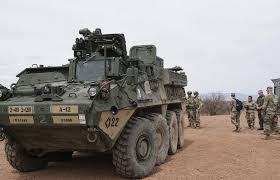
Over the next 45 days, the Defense Department will conduct tests to assume control of a portion of the Roosevelt Reservation located in New Mexico, to the east of Fort Huachuca, an Army base in Arizona, according to a U.S. official. During this timeframe, the Army plans to install additional fencing and signage to deter unauthorized access.
Individuals found in that area without proper authorization may face arrest by the Army’s security personnel, as indicated by officials who requested anonymity to discuss information that has not yet been publicly disclosed.
Any migrants apprehended by military forces on this land who are in the country unlawfully will be handed over to local civilian law enforcement, the officials noted.
It remains uncertain whether the acquisition of this land will necessitate the deployment of additional military personnel to the border. Currently, approximately 7,100 active-duty troops are under federal command at the border, alongside around 4,600 National Guard members operating under state authority.
Under the Posse Comitatus Act, military personnel are generally prohibited from engaging in civilian law enforcement activities on U.S. territory. However, an exception known as the military purpose doctrine permits such actions in specific circumstances, though it would likely not be applicable in this situation and could face legal challenges, according to Elizabeth Goitein, a specialist in presidential emergency powers at the Brennan Center for Justice.
This is due to the requirement that, despite being stationed on land classified as an Army installation, troops must demonstrate that their primary mission does not involve border security and law enforcement. The intent behind President Trump’s directive to transfer control of the Roosevelt Reservation to the military is to enhance border security, Goitein explained.
The military purpose doctrine “only applies if the law enforcement aspect is incidental,” Goitein stated. “Does this (area) serve a military purpose that is unrelated to enforcing customs and security at the border?”