


















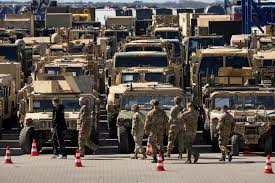
On Friday, Denmark’s parliament made a significant advancement in the process of ratifying a defense cooperation agreement with the United States, which enhances the rights of the US military within the Nordic nation, even amidst a diplomatic disagreement concerning Greenland.
On Friday, Denmark’s parliament made a significant move towards ratifying a defense cooperation agreement with the United States, which would enhance the rights of the US military within the Nordic nation, despite ongoing diplomatic tensions regarding Greenland.
Recent surveys indicate considerable resistance among the Danish populace to the proposed 10-year agreement, which, if approved, would allow the US military extensive access to deploy troops and store equipment on Danish territory.
Relations between the two historically allied NATO partners have been strained by US President Donald Trump’s demand for the United States to assume control of Greenland, a semi-autonomous territory of Denmark, citing security concerns.
Both the Danish and Greenlandic governments have firmly rejected the idea of relinquishing control of the resource-rich Arctic island to the United States.
Nevertheless, the Danish government, which entered into the bilateral cooperation agreement in 2023 during Joe Biden’s presidency, has emphasized the importance of strengthening Denmark’s defenses amid rising concerns over Russia’s actions in Europe, particularly in light of its ongoing conflict in Ukraine.
On Friday, the Danish parliament conducted the first of three readings of the bill, with a final vote anticipated by the end of June.
A member of Prime Minister Mette Frederiksen’s Social Democratic party defended the agreement, stating, “It would be extremely unwise to alienate the United States by discarding the most significant defense agreement in many years.”
Frederiksen echoed this sentiment on Tuesday, asserting, “The reality is that we have established the defense of Europe through our NATO membership. We aim to maintain that.”
The left-leaning Alternative and Red-Green Alliance parties have expressed their opposition to the agreement; however, it is expected to pass due to backing from several other opposition parties supporting the minority government’s initiative.
It is important to note that the agreement does not extend to Greenland, where the US already has considerable access through a defense pact established in the 1950s, nor does it include the Faroe Islands, another Danish territory in the North Atlantic.
In recent years, Finland, Sweden, and Norway have entered into bilateral defense agreements with the United States.