















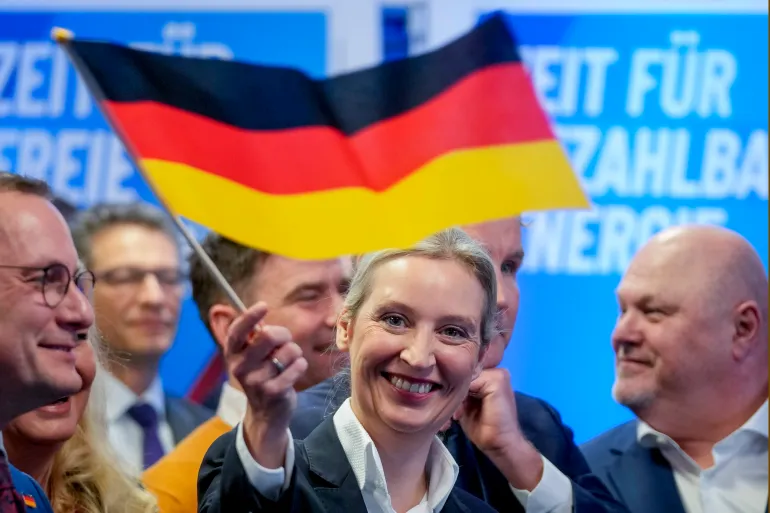
The Berlin Wall may have been dismantled in 1989, yet the legacy of the Cold War continues to influence German politics to this day.
In the 2025 German elections, the far-right Alternative for Germany (AfD) secured nearly all of its seats in the eastern regions that were formerly under Soviet control, while the Christian Democratic Union (CDU) dominated in the western regions that were aligned with the West.
Following World War II, the onset of the Cold War led to the division of Germany into two separate nations. The Soviet Union governed East Germany, imposing a communist regime, whereas the West administered West Germany, promoting liberal Western ideals. After enduring decades of authoritarian governance and economic difficulties under communism, the citizens of East Germany ultimately breached the Berlin Wall in 1989, which symbolized both a physical and ideological divide.
In this context, it is understandable that the AfD has established a strong presence in eastern Germany, previously governed by the Soviet Union. The party receives support from Russia, and its leader, Alice Weidel, maintains close ties with China, a key ally of Russia. Additionally, the party has garnered the endorsement of Elon Musk, a prominent supporter of former U.S. President Donald Trump, who has recently emerged as a significant partner to Russian President Vladimir Putin. U.S. Vice President JD Vance has also expressed support for the AfD.
A map produced by AFP illustrates the electoral victories of the AfD in the east and the CDU in the west of the nation.
Only two out of 48 seats in eastern Germany, outside of Berlin, were not won by the AfD.
This political divide is mirrored in economic and demographic disparities. The eastern regions experience a lower youth population, higher unemployment rates, and reduced per capita income compared to the west. Economic dissatisfaction is frequently cited as a primary factor driving individuals toward far-right ideologies.
In the recent German elections, the AfD nearly doubled its share of the vote, while the outgoing Chancellor Olaf Scholz’s Social Democratic Party (SPD) and the liberal Free Democratic Party (FDP) faced significant declines.