


















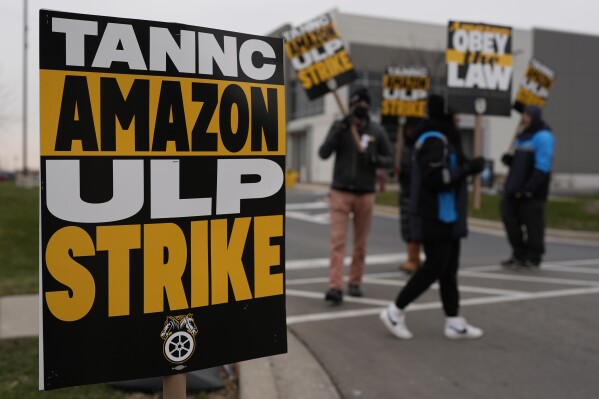
In the days leading up to Christmas, labor strikes in the United States pose a significant threat to the holiday season.
Amazon employees are currently on strike, and now Starbucks staff have joined the movement, which could impact festive activities. Although Amazon asserts that the strike is not expected to disrupt its operations, a prolonged walkout may result in shipment delays in specific metropolitan areas.
Overview of the Amazon workers’ strike: What transpired?
On Thursday, employees at seven Amazon facilities initiated a strike, organized by the Teamsters union, aimed at compelling the company to engage in labor negotiations during the peak shopping period. Workers from warehouses located in cities such as New York, Atlanta, and San Francisco participated in what union representatives characterized as the largest strike against Amazon to date. The Teamsters reported that the workers, who had recently voted to authorize strikes, commenced picketing after Amazon failed to adhere to a deadline established by the union for contract discussions.
The International Brotherhood of Teamsters claims to represent nearly 10,000 workers across 10 Amazon sites, which constitutes a small portion of the 800,000 employees in Amazon’s U.S. warehouses. The union has not disclosed the number of participants in the strike or its anticipated duration.
In a statement, Teamsters General President Sean O’Brien remarked, “Amazon is pushing its workers closer to the picket line by failing to show them the respect they have earned.”
An Amazon representative accused the Teamsters of deliberately misleading the public and asserted that the union has engaged in threats, intimidation, and attempts to coerce both workers and third-party drivers into participating in the strike.
Amazon operates numerous facilities throughout major metropolitan areas in the United States, which the company believes will mitigate significant disruptions. In 2023, Amazon reported sales of over 500 million items from independent sellers during the Black Friday and Cyber Monday shopping events.
Reasons for the Amazon workers’ strike: The striking workers are advocating for increased wages, enhanced benefits, and improved safety conditions in the workplace.
Since last year, the Teamsters have been striving to engage Amazon in negotiations, following their announcement of successfully unionizing a group of delivery drivers in California who work for an Amazon contractor. Amazon, which disputes the employment status of these workers, has declined to enter negotiations, prompting the union to file unfair labor practice charges with the National Labor Relations Board.
Additionally, warehouse workers in Staten Island, New York, who voted to unionize, are also seeking to commence contract discussions with Amazon.
Numerous employees have informed Reuters of their desire for the company to initiate negotiations and acknowledge the significant stress associated with meeting performance targets that adversely affect their health. Nevertheless, the striking workers constitute only a minor segment of the over 800,000 individuals employed by Amazon across more than 600 fulfillment centers, delivery stations, and same-day facilities in the United States.
Jordan Soreff, 63, who delivers approximately 300 packages daily for Amazon in Queens and Brooklyn, remarked, “(Amazon) claims there is no quota system, yet there exists a stringent quota system that compels individuals to exceed their physical limits in an unnatural manner.”
“The more you accomplish, the greater the expectations become.”
The ramifications of the strike on operations remain unclear. Amazon continues to employ hundreds of thousands of workers at delivery hubs and facilities that are not unionized.
The company has indicated that it does not anticipate the strike to disrupt operations during the holiday season. However, Teamsters President Sean O’Brien stated on Thursday morning that if customers encounter delivery delays, “they can attribute it to Amazon’s relentless greed.”
An Amazon representative clarified that the company strategically locates its facilities near customers, organizes shipping windows, and collaborates with other major carriers, such as UPS, to facilitate product deliveries.
“We have confidence in the robustness of our network and prepare for contingencies to mitigate any potential operational impact or costs,” the spokesperson stated.
Starbucks Workers’ Strike: Reasons Behind the Planned Protests
The union representing more than 10,000 Starbucks baristas has announced intentions to strike in Los Angeles, Chicago, and Seattle, citing ongoing issues related to wages, staffing, and scheduling.
Workers United, which advocates for employees at 525 Starbucks locations across the United States, indicated on Thursday that the strikes could escalate daily, potentially impacting hundreds of stores nationwide by December 24 if a resolution is not achieved.
The union has urged the Seattle-based coffee company to address demands for wage increases, improved staffing conditions, and more favorable scheduling practices. A five-day strike has been announced, which may disrupt holiday sales.
In response, Starbucks expressed its readiness to continue negotiations, asserting that union representatives concluded this week’s discussions prematurely. The company stated, “It is disappointing they didn’t return to the table given the progress we’ve made to date. We are ready to continue negotiations to reach agreements. We need the union to return to the table.”
Starbucks noted that since April, it has engaged in over nine bargaining sessions with Workers United, resulting in more than 30 agreements on various topics, including economic matters.
The company is currently undergoing transformations under its new CEO, Brian Niccol, who has committed to revitalizing the brand’s “coffee house culture.” His initiatives include redesigning cafes, enhancing seating comfort, reducing customer wait times to under four minutes, and streamlining the menu.
This year, Starbucks has encountered difficulties, with sales declining for three consecutive quarters—a rare occurrence. Customers have expressed dissatisfaction with high drink prices and extended wait times, while unionization efforts at numerous stores have highlighted concerns regarding pay, benefits, and working conditions.
As holiday strikes loom, disruptions to your coffee purchases may be anticipated this festive season.