


















Paris, France:
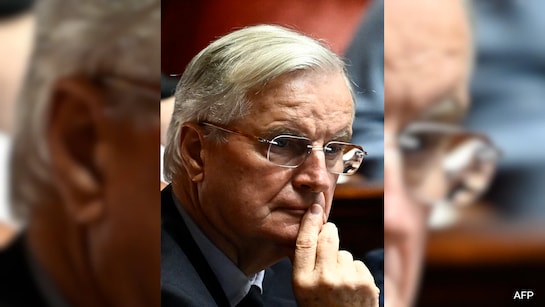
On Wednesday, the French government is set to confront no-confidence votes that could lead to the downfall of Prime Minister Michel Barnier’s brief administration, potentially thrusting the nation into a period of significant political instability.
Should Barnier’s government be ousted after merely three months in power, President Emmanuel Macron would face the challenging task of selecting a suitable successor. The National Assembly is scheduled to deliberate on two motions introduced by both the far-left and far-right factions, stemming from a conflict with Barnier regarding the budget for the upcoming year. This conflict was exacerbated when the Prime Minister pushed through a social security financing bill without a vote.
The far-right National Rally (RN), led by three-time presidential candidate Marine Le Pen, is anticipated to support the motion proposed by the left, thereby providing sufficient votes for its passage. When asked on French television about the possibility of his government surviving the vote, Barnier expressed optimism, stating, “I want this and it is possible…I think it is possible that there is this reflex of responsibility where — beyond political differences, divergences, the normal contradictions in a democracy — we tell ourselves that there is a higher interest.”
However, most analysts are skeptical about the government’s survival, given the unlikely alliance between the far-right and the left.
This political turmoil follows a snap election called by Macron during the summer, which failed to curb the rise of the far-right and resulted in no single party or faction holding a majority in parliament. Barnier assumed office with the looming threat of the far-right under Le Pen, which could dismantle the government at any moment.
With new elections prohibited within a year of the last legislative polls, Macron’s options are severely limited. Some observers have proposed that the president, currently concluding a state visit to Saudi Arabia, should consider resigning to resolve the ongoing political deadlock.
Macron dismissed the calls for his resignation, characterizing such a scenario as “political fiction.”
“It is frankly inadequate to make such statements,” Macron remarked to reporters during his visit to Saudi Arabia.
“I have been elected twice by the French populace. I take immense pride in this and will fulfill this trust with all my energy until the very last moment to serve the country,” he continued, noting that his term extends until 2027.
Several notable opposition leaders, along with some individuals within the presidential camp, have indicated that resignation might be Macron’s only feasible course of action.
‘Uncertainty just before Christmas’
Olivier Faure, the head of the Socialist Party, urged Macron to clarify his intentions should the Barnier government collapse. “Instead of making vague comments during a visit to Saudi Arabia, Emmanuel Macron must now address the French people directly,” Faure stated in an interview with Le Monde published on Wednesday. “How can he leave the French citizens in this state of uncertainty just before Christmas?”
In response, Macron accused Le Pen’s National Rally of exhibiting “unbearable cynicism” by supporting the no-confidence motion.
“We must not alarm the public with such matters,” he asserted.
Macron expressed some optimism regarding the government’s survival, stating he could “not believe” that the motion would succeed.
Potential candidates for the prime minister position are limited, with loyalist Defence Minister Sebastien Lecornu and Macron’s centrist ally Francois Bayrou being possible contenders. Should the government fall, it would mark the first successful no-confidence vote since Georges Pompidou’s government was defeated in 1962, during Charles de Gaulle’s presidency.
The duration of Barnier’s government would also be the shortest in the history of France’s Fifth Republic, established in 1958.
Some analysts have suggested that Le Pen, 56, is attempting to destabilize Macron before the conclusion of his term by seeking to oust Barnier.
Le Pen is currently involved in a prominent embezzlement trial. Should she be convicted in March, she may be prohibited from running in the upcoming presidential election in France.
Nonetheless, she has maintained that the dispute centers solely on a budget she claims would impoverish the French populace.
In her social media remarks, she stated that by adhering to the “catastrophic continuity of Emmanuel Macron,” the prime minister “could only fail.”