


















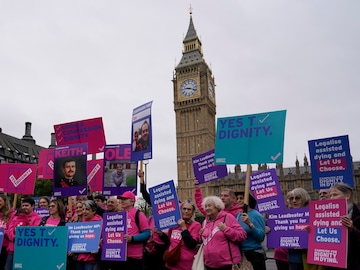
Members of Parliament in the House of Commons voted on Friday in support of a landmark bill that may allow terminally ill adults in England and Wales, with a prognosis of six months or less to live, to seek medical assistance in ending their lives.
The Terminally Ill Adults (End of Life) Bill, introduced as a private member’s bill by Labour MP Kim Leadbeater, received 330 votes in favor compared to 275 against, thus successfully passing its second reading with a majority of 55. This advancement enables the legislation to move forward through a comprehensive process of amendments and examination by the House of Lords before it can be enacted into law.
The topic has significantly polarized MPs, who were permitted a free vote, unbound by party affiliations, in determining their stance on this crucial legislation.
“Citizens nationwide will be closely monitoring today’s vote, as this is fundamentally a matter of personal conscience,” stated a spokesperson for Prime Minister Keir Starmer, who supported the bill. The spokesperson emphasized that it is the responsibility of Parliament to deliberate on legal changes, noting that the Prime Minister has publicly committed to refraining from exerting influence on others regarding their voting decisions. Each MP must independently evaluate their position when the vote occurs, the spokesperson added.
Leadbeater, who has been vigorously advocating for this cause for several weeks, has asserted that her bill includes “the most robust safeguards” of any assisted dying legislation globally.
The process requires the approval of two independent physicians, followed by a high-court judge, with the individual being responsible for administering the medication themselves.
Additionally, the legislation stipulates a maximum prison sentence of 14 years for anyone who pressures another individual into seeking assisted dying or consuming lethal substances.
“We are not discussing a choice between life and death – we are discussing providing individuals with the option of how to die,” she stated to Members of Parliament during a five-hour debate in the Commons. In the days preceding the vote on Friday, the bill garnered significant support from notable figures, including former Prime Minister David Cameron, who contended that individuals in severe pain facing imminent death should have the option to alleviate their suffering.
Conversely, opponents of the bill expressed concerns that such legislation could endanger vulnerable individuals, potentially leading them to feel coerced into opting for assisted dying.
This week’s vote represented a significant shift from the previous occasion when a similar bill was considered in the UK Parliament, which was decisively rejected at the same second reading stage in 2015. Among the supporters of the bill this week was newly elected British Indian Conservative MP Neil Shastri-Hurst, a former surgeon and medical barrister, who advocated for individuals to have access to “the death they deserve.” Former Prime Minister Rishi Sunak and Culture Secretary Lisa Nandy were also among the British-Indian MPs who voted in favor of the bill.
In contrast, shadow foreign secretary Priti Patel and former home secretary Suella Braverman were among those who opposed it.