


















Moscow:
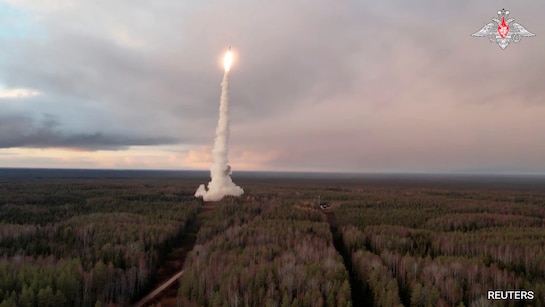
Russia has launched an Inter-Continental Ballistic Missile (ICBM) at Ukraine, occurring just one day after President Vladimir Putin revised Moscow’s nuclear strategy. The deployment of the ICBM, equipped with a conventional warhead rather than a nuclear one, serves as a significant warning to Ukraine and its Western allies, emphasizing the necessity of adhering to Moscow’s established boundaries.
ICBMs, which are primarily designed to deliver nuclear payloads, can also be utilized with conventional warheads. The underlying principles, technology, and design of ICBMs were developed to ensure a nation’s preparedness in the event of a nuclear confrontation. Moscow’s decisive action follows recent approvals from US President Joe Biden and UK Prime Minister Keir Starmer, permitting Ukraine to employ Western long-range cruise and ballistic missiles to strike deep into Russian territory. Shortly after these endorsements from Washington and London, Kyiv launched a US-manufactured ATACMS missile and a UK-produced ‘Storm Shadow’ missile aimed at Russian locations.
According to Kyiv, this marks the first instance of Moscow deploying an ICBM, coinciding with significant escalations in the conflict, which recently reached its 1,000th day. The Ukrainian Air Force issued a statement today indicating that Russian forces had targeted the central Ukrainian city of Dnipro with various missile types this morning, with the objective of damaging Ukrainian infrastructure.
The statement further noted that “an intercontinental ballistic missile was launched from the Astrakhan region of the Russian Federation.” An AFP news report cited a source within the Ukrainian Air Force confirming that this was the first occasion an ICBM had been fired since the onset of the war in Ukraine.
When approached for comments regarding the ICBM launch, Moscow refrained from providing a response. Kremlin spokesperson Dmitry Peskov stated that he had “nothing to say on this topic.”