


















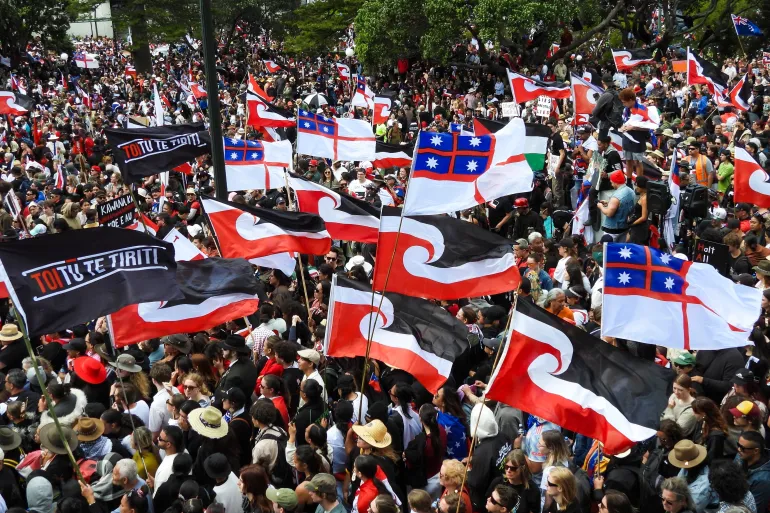
Tens of thousands gathered outside the Parliament of New Zealand to voice their opposition to a proposed bill that critics argue would undermine the rights of the Maori population.
On Tuesday, approximately 42,000 individuals participated in the demonstration, urging legislators to reject the Treaty Principles Bill, which was introduced earlier this month by the libertarian ACT New Zealand party. Although the bill, put forth by the junior partner in the centre-right coalition government, currently lacks sufficient support for passage, opponents express concern that it may exacerbate societal divisions. They contend that the legislation aims to dismantle decades of initiatives designed to empower the Maori community, which constitutes about 20 percent of the nation’s 5.3 million residents but experiences higher rates of deprivation, incarceration, and poorer health outcomes compared to the general population.
The protest on Tuesday followed a nine-day hikoi, or march in the Maori language, that commenced in the northernmost part of the country. Thousands participated in rallies across various towns and cities as the marchers made their way southward to Wellington, both on foot and by vehicle.
Among the demonstrators, some donned traditional attire, complete with feathered headgear and cloaks, while others brandished traditional Maori weapons. Additionally, many wore T-shirts featuring the phrase “Toitu te Tiriti” (Honour the Treaty), and hundreds displayed the Maori national flag.
The proposed legislation aims to reinterpret the Treaty of Waitangi, which has been in existence for 184 years. This treaty provides Maori tribes with extensive rights to maintain their lands and safeguard their interests in exchange for relinquishing governance to the British. The treaty continues to influence contemporary legislation and policy, with judicial decisions and a distinct Maori tribunal progressively enhancing Maori rights and privileges over the years.
The coalition partners of ACT, namely the National Party and New Zealand First, have expressed their support for the legislation during its initial reading. However, both parties have indicated that they will not endorse its progression into law.
Critics, including former conservative Prime Minister Jenny Shipley, argue that merely introducing the bill poses a risk of creating divisions within New Zealand.
On Thursday, Parliament members cast their votes on the bill, during which Hana-Rawhiti Maipi-Clarke, a legislator from the Te Pati Maori party, dramatically tore up a copy of the bill and led her colleagues in a traditional haka performance.