


















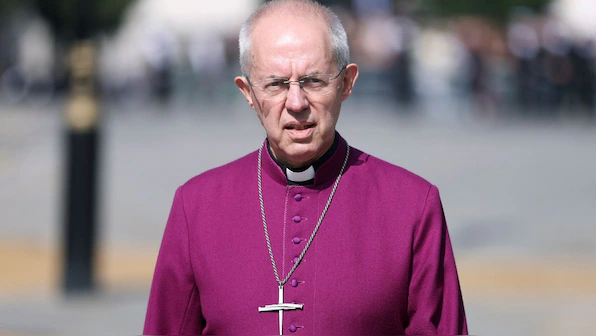
The Church of England is facing significant scrutiny regarding the concealment of one of its most severe abuse scandals. Under mounting pressure, Archbishop of Canterbury Justin Welby has announced his resignation following a critical report released last week, which revealed his failure to take action upon learning of the abuse of boys and young men several decades ago.
Welby, who had previously resisted calls to resign, made his announcement on Tuesday, November 12. In his resignation letter, he stated, “Having sought the gracious permission of His Majesty The King, I have decided to resign.”
As the spiritual leader of 85 million Anglicans worldwide, Welby expressed that his decision was made “in the best interests of the Church of England, which I dearly love and which I have been honoured to serve.” The Makin review has brought to light the long-standing culture of silence surrounding the egregious abuses committed by John Smyth. When I was informed in 2013 and led to believe that the police had been alerted, I mistakenly thought that a suitable resolution would ensue.
“It is abundantly clear that I must accept both personal and institutional responsibility for the prolonged and retraumatizing period from 2013 to 2024.” He expressed his resignation with “sorrow for all victims and survivors of abuse.”
UK Church Abuse Scandal
An independent review led by Keith Makin, a former director of social services, has revealed that John Smyth, a prominent British lawyer, perpetrated abuse against over 100 boys and young men in the United Kingdom and Africa during the 1970s and 1980s at Christian summer camps.
The findings indicate that Smyth became “arguably, the most prolific serial abuser to be associated with the Church of England” over a span of four decades. His victims included 130 boys and young men from three countries: the UK, Zimbabwe, and potentially South Africa. Smyth inflicted severe physical, sexual, psychological, and spiritual harm on private schoolboys attending evangelical Christian holiday camps, as reported by The Guardian.
The abuse was first uncovered in an investigation by Channel 4 News in February 2017, which detailed how Smyth groomed his victims at Christian summer camps, universities, and Winchester College, ultimately subjecting them to brutal beatings.
According to the New York Times, the Makin report highlighted that Smyth manipulated his victims into believing “that the way to Christ was through suffering.”
The report emphasized that “the impact of that abuse is impossible to overstate and has permanently marked the lives of his victims.”
The report further indicated that there was “clear evidence” of the abuse committed by John Smyth in the UK, which was “covered up,” minimized, and kept “secret” since at least 1982, and possibly even earlier.
The Makin report asserts that the Church of England was aware of the abuse “at the highest level” since July 2013. Justin Welby became aware of the allegations against Smyth around August 2013, shortly after assuming the role of Archbishop of Canterbury. The review determined that Smyth could have faced legal consequences had Welby reported the matter to the police following his appointment as archbishop eleven years ago.
Welby had volunteered at holiday camps during the 1970s. According to the Makin report, he encountered Smyth at various Christian summer camps organized by the Iwerne Trust between 1975 and August 1979. The report states, as reported by the BBC, “We have explored with Justin Welby his relationship at that time with John Smyth. He knew John Smyth from the Iwerne camps and was in John Smyth’s dormitory for two camps.”
Welby described being “impressed” by Smyth, noting his apparent intellectual prowess and charismatic personality. However, he stated that they were never particularly close.
Smyth has denied any knowledge of Smyth’s physical abuse, a claim the report deems “unlikely.” It suggests that while Welby may not have been fully aware of the extreme nature of the abuse, it is highly probable that he possessed some level of awareness regarding concerns about John Smyth. The review concluded that it is impossible to determine whether Welby was aware of the severity of the abuses in the UK prior to 2013, as cited by The Guardian.
In response to the Makin report, Welby stated that he had “no idea or suspicion of this abuse before 2013,” while acknowledging that he “personally failed” to ensure a thorough investigation of the abuse allegations.
The report revealed that Smyth’s “appalling” actions were recognized in the 1980s, yet the church did not expose him, allowing him to leave the UK and continue his abusive behavior abroad.
The influential lawyer passed away in 2018 in Cape Town, South Africa, while he was under investigation by Hampshire Police in the UK, as reported by Sky News.
Archbishop of Canterbury Resignation
The independent review published last week sparked significant controversy, leading to increased calls for Archbishop of Canterbury Welby, the leader of the Church of England, to resign.
Welby indicated last week that he had contemplated resigning due to his “shameful” choice not to act on the abuse reports concerning Smyth in 2013.
Nevertheless, Lambeth Palace announced on Monday (November 11) that Welby had “profoundly apologized for his own failures and omissions, as well as for the wickedness, concealment, and abuse perpetrated by the church at large,” while confirming that he did not plan to resign.
Approximately 1,500 church members, including some from the General Synod—the church’s governing body—signed a petition urging the archbishop to step down.
As the pressure mounted, the Archbishop of Canterbury declared his intention to retire, shortly after UK Prime Minister Keir Starmer refrained from publicly supporting him.
On Monday, Bishop of Newcastle, Helen Ann Hartley, became the highest-ranking clergy member to call for Welby’s resignation.
However, some argue that Welby’s resignation is a secondary concern.
James, a survivor of Smyth’s abuse, expressed to The Guardian, “Many other senior clerics were aware of Smyth’s abuse from an early stage. Simply replacing the Archbishop of Canterbury without a genuine cultural shift is insufficient in my view.”
Andrew Graystone, an author who has documented Smyth’s abuse, criticized the prevailing culture of “cover-up and secrecy” within the church during an interview with the BBC. He emphasized that the resignation of the Archbishop of Canterbury alone is insufficient to effect meaningful change.
What are the next steps?
The process of appointing a new Archbishop of Canterbury may extend over several months.
According to the regulations of the Church of England, the Crown Nominations Commission will be responsible for selecting Welby’s successor. This committee will present two candidates to the Prime Minister, ranked in order of preference.