


















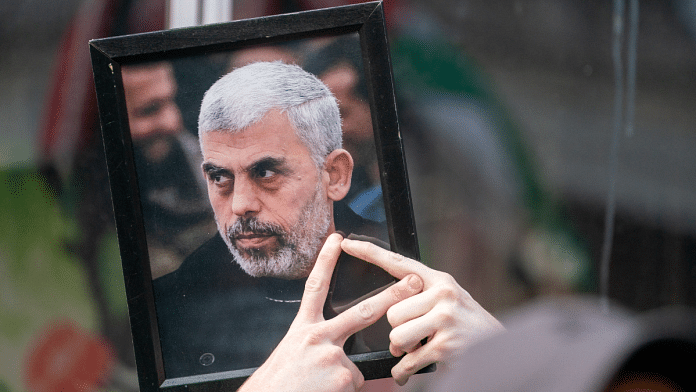
New Delhi:Yahya Sinwar, known as the ‘Butcher of Khan Younis’ and the leader of Hamas’ political faction, was confirmed dead by Israeli authorities on Thursday. He was one of the key figures behind the attack on Israel on October 7, 2023.
Sinwar, labeled a “dead man walking” by Israel following the assault that ignited the Gaza conflict, transitioned from an enforcer for the Muslim Brotherhood and early Hamas to becoming the organization’s chief in 2017, ultimately assuming leadership of its political bureau in August of this year.
The elimination of Sinwar in Rafah marks a significant achievement for Israel after an extensive year-long pursuit. However, Israeli Prime Minister Benjamin Netanyahu has stated that this event signifies “not the end of the war in Gaza, but the beginning of the end.”
With the deaths of both Sinwar and Mohammed Deif, the former head of Hamas’ military wing, Tel Aviv has successfully targeted what it considers the two principal architects of ‘Operation al-Aqsa Flood’—the operation that resulted in Hamas militants infiltrating Israeli communities, leading to the deaths of nearly 1,200 individuals and the abduction of 251 hostages taken into the Gaza Strip.
Currently, approximately 101 hostages remain in Gaza. In response to the initial attack, Israeli retaliation has reportedly resulted in over 42,000 Palestinian fatalities, according to the Gaza health ministry, while extensive areas of Gaza have been reduced to ruins.
Deif was assassinated in July 2024. Over the preceding year, Israeli forces successfully eliminated several prominent leaders of Hamas and its ally Hezbollah in southern Lebanon, among them Ismail Haniyeh and Hassan Nasrallah.
Who was Yahya Sinwar?
Sinwar was born in 1962 within the confines of the Khan Younis refugee camp located in southern Gaza. His family originally hailed from al-Majdal, a Palestinian village from which they were forcibly displaced by Israel during the Nakba in 1948. The village of al-Majdal was subsequently renamed Ashkelon in 1950 following the expulsion of the last Palestinian residents.
By the time of Sinwar’s birth, fourteen years after the Nakba, the Khan Younis refugee camp had evolved into a semblance of a town, although it was under Egyptian occupation.
When he reached the age of five, Israel had successfully defeated the Arab nations in the 1967 Six-Day War, resulting in the occupation of the Gaza Strip by Tel Aviv.
During the 1980s, while pursuing his studies in Arabic at the Islamic University of Gaza, Sinwar became involved with the Islamic Bloc, the student faction of the Muslim Brotherhood, ultimately rising to the position of its leader. According to the BBC, he was first apprehended by Israeli security forces in 1982 while still a young university student. By 1985, Sinwar had established the enforcement branch of the Muslim Brotherhood and subsequently took charge of Hamas’s internal security organization, al-Majd, following the group’s formation in 1987.
By that time, Sinwar had garnered a reputation for his ruthless enforcement tactics and had formed a close association with the group’s founder, Sheikh Ahmed Yassin. The Washington Post noted that Sinwar regularly prayed at the same mosque as Yassin in Gaza City.
In January 1988, he was arrested by Israeli authorities and sentenced to four life terms plus an additional 30 years for his role in founding al-Majd and for the murder of four Palestinians. During his interrogation, Sinwar reportedly confessed to committing at least 12 murders, as reported by The Post.
As the leader of al-Majd, he became notorious for his severe methods of punishing those accused of moral transgressions or collaboration with Israel, according to the BBC. He was known to use a machete to behead suspected collaborators and, in one instance, buried a person alive in a grave, as detailed by The New Yorker.
Most stories of Sinwar’s ruthlessness and brutality have come from the accounts of Israeli interrogators, which have been widely reported.
From Israeli prisons to architect of 7 October
Sinwar was incarcerated from 1988 until 2011. During his imprisonment, it was reported that he immersed himself in Israeli newspapers, radio broadcasts, and literature, ultimately achieving fluency in Hebrew to gain a deeper understanding of his adversaries.
While in prison, Sinwar remained active, targeting inmates suspected of collaboration and transmitting covert messages to Hamas operatives outside the facility.
His brother, Mohammed Sinwar, was believed to have played a significant role in the 2006 operation that resulted in the abduction of Israeli soldier Gilad Shalit by Hamas.
In 2011, Sinwar was one of the 1,027 Palestinians released by Israel as part of a prisoner exchange for Shalit’s release.
Shortly after his release, Sinwar married Samar, a woman 18 years younger than himself, and they eventually had three children. His lengthy imprisonment contributed to a hardened public persona, which facilitated his rapid ascent within Hamas.
Reports indicate that in 2012, Sinwar traveled to Tehran to meet with General Qassem Soleimani, the commander of the Iranian Revolutionary Guard Corps’ al-Quds Force.
He established connections with Haniyeh and Deif, and in 2017, as Haniyeh assumed leadership of Hamas’ political wing, Sinwar became the head of the organization in Gaza.
In the initial years of his leadership, Sinwar frequently articulated a more conciliatory perspective on Hamas’ resistance against Israel, asserting that conflict was not beneficial for anyone. However, as financial support from Qatar increased, Sinwar began to develop an extensive tunnel network within the Gaza Strip and equipped the militia with advanced weaponry.