


















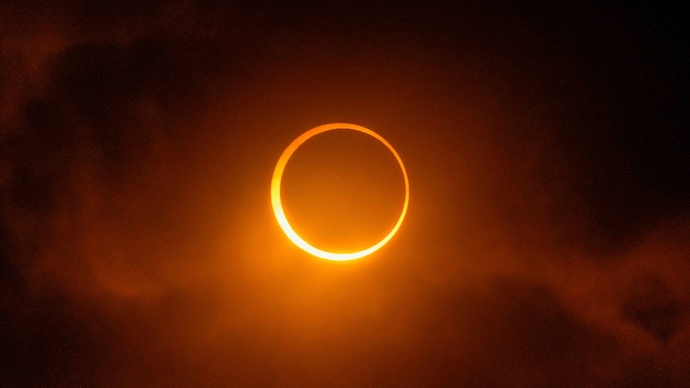
A remarkable celestial event captivated observers in various regions around the globe — an annular solar eclipse, commonly referred to as the “ring of fire.”
Yesterday, numerous locations experienced this extraordinary phenomenon — an annular solar eclipse, frequently called a “ring of fire” eclipse. This event transpires when the Moon aligns directly between the Earth and the Sun; however, due to the Moon’s distance from Earth, it fails to entirely obscure the Sun’s disk.
At the height of the eclipse, the Sun’s outer edges remained visible, creating a brilliant, fiery ring encircling the Moon. This effect occurred because the Moon was at or near its apogee, the point farthest from Earth, resulting in its smaller appearance in the sky. Consequently, rather than a total eclipse, viewers were treated to the luminous “ring of fire.”
The eclipse commenced its path across the globe on Wednesday at 9:12 PM IST in the Southern Pacific Ocean. The annularity path, where the ring of fire could be observed, reached a maximum width of approximately 265 km. It made landfall in southern Chile around 10:20 PM IST and traversed parts of Argentina before concluding in the southern Atlantic Ocean at 2:09 AM IST on Thursday.
One of the most intriguing locations for viewing was Easter Island, also known as Rapa Nui, where this remote Chilean territory experienced 87% coverage of the Sun’s disk, with the annular phase visible from 9:33 PM to 9:39 PM IST. Regrettably, this spectacular event was not observable from India, as no portion of the eclipse could be seen from the country.