















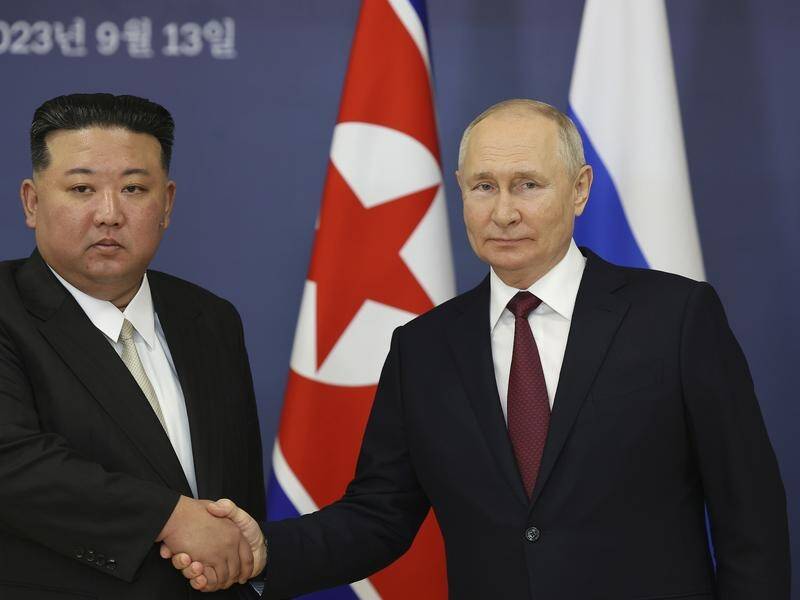
Vladimir Putin, in a letter published by North Korean state media, assured his commitment to building trade and security systems with North Korea that are independent from Western control.
The letter, featured in North Korea’s Rodong Sinmun, emphasized the strong and equal relationship between the two nations over the past seven decades, founded on principles of equality, trust, and mutual respect.
Putin expressed the intention to establish alternative trade mechanisms and settlement systems that are not subjected to Western influence. Additionally, he emphasized the joint effort to resist unilateral restrictions that are deemed illegitimate. Furthermore, Putin highlighted the need to construct a comprehensive and equitable security architecture in Eurasia.
The Russian president expressed his gratitude to North Korea for supporting Russia’s special military operation in Ukraine and pledged unwavering support to Pyongyang in defending its interests against what he characterized as “U.S. pressure, blackmail, and military threats.”
This article was released a day after the announcement of Putin’s planned visit to North Korea, marking the first visit in 24 years. The two countries are considering signing a partnership agreement during the visit, which may cover security matters. The adviser to Putin on foreign policy, Yuri Ushakov, clarified that the agreement would not be aimed against any particular country but would instead focus on outlining future cooperation prospects based on the recent developments in international politics and economics, including security concerns.
Russian Defence Minister Andrei Belousov, Foreign Minister Sergei Lavrov, the ministers for natural resources, health, and transport, the heads of the Russian space agency and its railways, and Deputy Prime Minister Alexander Novak, who is responsible for energy, will be part of the delegation.
According to Russia’s Interfax news agency, the visit will consist of private discussions between the two leaders, a grand concert, a formal reception, honor guards, the signing of documents, and a statement to the media, as stated by Assistant to the Head of State Yuri Ushakov.
Prior to the visit, North Korea seems to have been preparing for a potential military parade in downtown Pyongyang, as shown by commercial satellite images.
On Monday, U.S. State Department spokesperson Matthew Miller reiterated allegations that North Korea had provided “dozens of ballistic missiles and over 11,000 containers of munitions to Russia” for use in Ukraine.
Miller stated that the United States has observed Putin becoming increasingly desperate in recent months and seeking assistance from Iran and North Korea to compensate for equipment lost on the battlefield.
Both Moscow and Pyongyang have denied any arms transfers.
Victor Cha, a former U.S. national security official now affiliated with the Center for Strategic and International Studies, declared that the summit poses the greatest threat to U.S. national security since the Korean War.
In a report published on Monday, Cha emphasized that this long-standing relationship, which has been revitalized by the conflict in Ukraine, undermines the security of Europe, Asia, and the United States.
He urged Washington to collaborate with Europe and other partners to intensify economic and diplomatic pressure on Pyongyang, engage with China, and launch a comprehensive campaign focused on human rights and information dissemination to inundate the isolated North with external media.
Formerly known as the Democratic People’s Republic of Korea (DPRK), North Korea has been subjected to U.N. sanctions due to its ballistic missile and nuclear programs since 2006. These measures have been progressively strengthened over time.
In recent years, the Security Council has faced divisions regarding the approach to be taken towards Pyongyang. Russia and China argue that imposing additional sanctions will not be beneficial and advocate for the easing of existing measures. Although they proposed the lifting of certain sanctions in December 2019, they have never brought their draft resolution to a vote.
In May 2022, both Russia and China vetoed a U.S.-led initiative to impose further U.N. sanctions on North Korea following its renewed ballistic missile launches. Subsequently, Russia vetoed the renewal of a panel of experts responsible for monitoring the enforcement of U.N. sanctions in March of this year.
China and Russia contend that joint military exercises conducted by the United States and South Korea provoke Pyongyang, while Washington accuses Beijing and Moscow of emboldening North Korea by shielding it from additional sanctions.
Following his visit to North Korea, Putin is scheduled to travel to Vietnam on June 19-20.