
















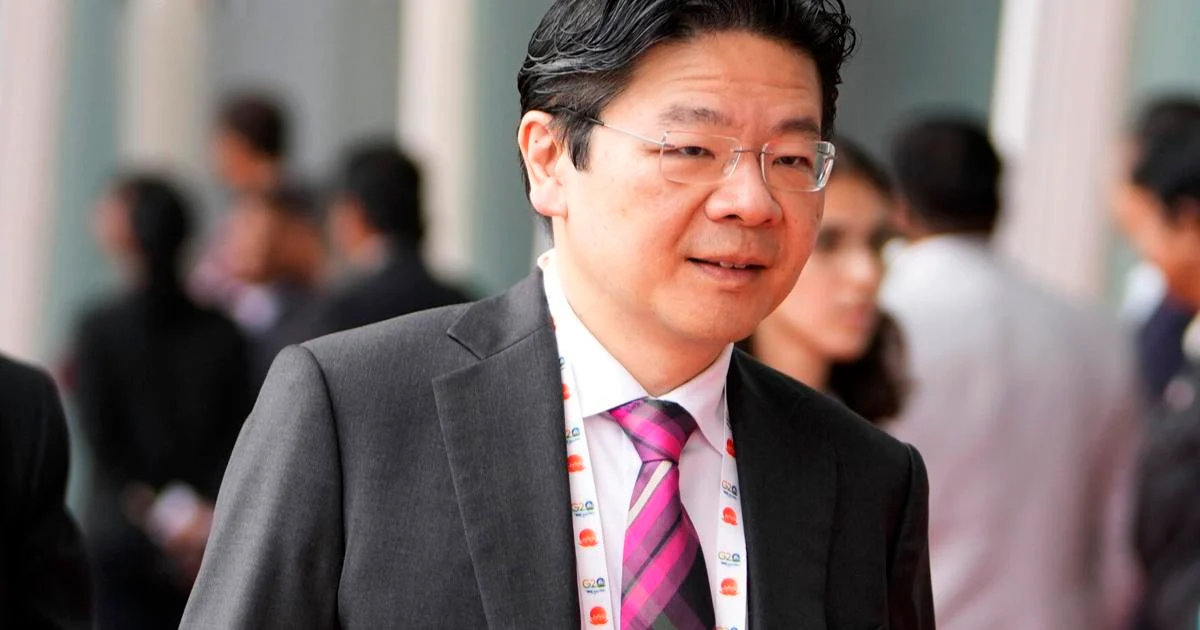
Singapore’s newly appointed Prime Minister, Lawrence Wong, expressed his commitment to improving the future during his inauguration ceremony on Wednesday.
The carefully orchestrated political succession aims to maintain stability in Singapore, a prominent financial hub in Asia.
At 51 years old, Mr. Wong, an economist trained in the United States, takes over from Lee Hsien Loong, who served as Prime Minister for two decades before stepping down. He is the fourth leader of the city-state and the first to be born after Singapore gained independence in 1965.
The departure of Mr. Lee marks the end of a family dynasty that was led by his father, Lee Kuan Yew, the first leader of Singapore. During his 31-year tenure, Lee Kuan Yew transformed the former colonial trading outpost into one of the wealthiest nations in the world.
In his address, Prime Minister Wong acknowledged the contributions of his predecessors and emphasized the need for a different leadership approach in navigating Singapore through the challenges of an increasingly uncertain world. He stated, “We stand on the shoulders of giants, but we will lead in our own way. We will continue to think boldly and think far.”
The transition of power has been meticulously planned by the People’s Action Party, a long-standing political party known for its effective governance and integrity. It is anticipated that this change in leadership will not significantly alter the dynamics of the small nation, which is home to approximately 6 million people.
Mr. Wong, a former civil servant who transitioned into politics, rose to prominence for his role in leading Singapore’s successful fight against COVID-19. However, he was not initially the preferred candidate for the top position.
Initially, Heng Swee Keat, a former central bank chief and education minister, was chosen as the successor but withdrew his nomination in 2021. Subsequently, Mr. Wong was selected by the People’s Action Party in 2022 to fill the void and was swiftly promoted to deputy prime minister.
In light of the challenges posed by an increasingly chaotic and volatile world, Mr. Wong cautioned that Singapore must remain united and forge new paths. He emphasized that protectionism and rampant nationalism would only exacerbate global tensions.
Amidst the rivalry between China and the United States, Mr. Wong affirmed Singapore’s commitment to engage with both nations, maintaining its neutral stance.
As he prepares for his first major test in the upcoming general elections, Mr. Wong has retained his position in the Cabinet and continues to oversee the finance portfolio. Prior to assuming office, he appointed Trade Minister Gan Kim Yong as one of the deputy premiers, with the other deputy being Mr. Heng.
Mr. Lee, the former premier, has assumed the role of senior minister, following the path taken by all previous premiers.
While victory in the elections is expected, Mr. Wong must secure a stronger mandate after the setback suffered by the People’s Action Party in the 2020 polls, which reflected growing discontent among voters towards the government.
Under Mr. Lee’s leadership, Singapore has flourished into one of the world’s wealthiest nations, but it has also become one of the most expensive cities to reside in. The People’s Action Party has faced criticism for its tight control over the government, a perceived “government-knows-best” approach, media censorship, and the use of oppressive laws against dissidents.
Issues such as income inequality, unaffordable housing, overcrowding due to immigration, and restrictions on freedom of speech have been exploited by the opposition, weakening the People’s Action Party’s hold on power.
Eugene Tan, a law professor at Singapore Management University, mentioned that the weakening of one-party dominance in Singapore poses a challenge for the PAP leadership, emphasizing the need to slow down this process.
Bridget Welsh, a political expert specializing in Southeast Asia, highlighted Lee’s successful navigation of turbulent times, such as the 2008-2009 financial crisis and COVID-19, contributing to Singapore’s resilience. However, Welsh also pointed out the increasing complexity of Singaporean society, with growing demands, which presents a more challenging governance task for Wong.
Wong, born seven years after Singapore’s independence, comes from humble beginnings, unlike many senior PAP leaders. His background, observers suggest, may enable him to better connect with the average citizen.
Having pursued studies in the U.S. and holding masters’ degrees in economics and public administration from prestigious universities, Wong has served in various public service roles before entering politics in 2011. He has managed portfolios in defense, education, communications, culture, community, and youth.
Similar to Lee, Wong is active on social media, sharing insights into his interests in music, dogs, and tennis. He has initiated the Forward Singapore plan, aiming to involve Singaporeans in shaping a more balanced, vibrant, and inclusive agenda for the future.
In a commitment to the people of Singapore, Wong pledged, “This is my promise to all Singaporeans. I will serve you with all my heart. I will never settle for the status quo. I will always seek better ways to make tomorrow better than today.”
Tan, a law professor, mentioned that Mr. Wong will need to focus on tackling pressing concerns such as the increasing cost of living, accessibility to housing, and ensuring job stability. He emphasized the importance of addressing basic needs, as they are crucial for any country, especially considering Singapore’s inherent vulnerabilities.