


















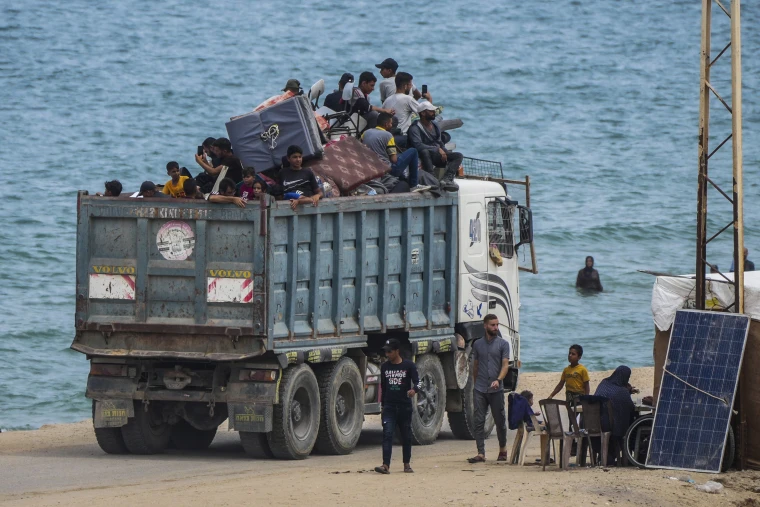
Israel has issued new evacuation orders in Gaza’s southern city of Rafah on Saturday, compelling tens of thousands more individuals to relocate as it readies to extend its operation.
Additionally, it has announced its advancement into a region in northern Gaza where Hamas has regrouped.
Israel has now cleared out the eastern third of Rafah, pushing the operation towards the outskirts of the densely populated central area. However, Israel’s incursion into the city has not yet escalated to the full-scale invasion it had initially planned.
This directive has been met with significant international opposition and criticism. U.S. President Joe Biden has already declared that offensive weapons will not be provided to Israel for Rafah. Furthermore, the U.S. stated on Friday that there was “reasonable” evidence of Israel violating international law protecting civilians in its conduct of the conflict against Hamas — marking the strongest stance the Biden administration has taken on the issue thus far.
The United Nations and other organizations have been cautioning for weeks that an Israeli attack on Rafah, which shares a border with Egypt near major aid entry points, would severely impede humanitarian efforts and result in a catastrophic increase in civilian casualties.
Over 1.4 million Palestinians — half of Gaza’s population — have sought refuge in Rafah, with most fleeing from Israel’s offensives in other areas. As the last sanctuary in the strip, the evacuations are compelling individuals to return north to regions previously devastated by Israeli attacks. Aid agencies estimate that 110,000 had already relocated before the recent order, which now adds an additional 40,000 to that figure.
With people being displaced multiple times, there are limited safe havens left in the embattled strip. Those who fled the recent conflict have set up new tent camps in the city of Khan Younis — which was partially destroyed in a previous Israeli offensive — and in the city of Deir al-Balah, placing strain on the existing infrastructure.
Georgios Petropoulos, a representative from the U.N. Office for Coordination of Humanitarian Affairs stationed in Rafah, expressed that humanitarian workers are facing a shortage of essential supplies needed to establish themselves in new locations. He emphasized the lack of tents, blankets, bedding, and other necessary items that are typically provided by the humanitarian system to assist populations on the move.
Israeli forces have taken control of the Gaza side of the Rafah crossing, resulting in its closure. This crossing was a crucial entry point for fuel supplies.
Petropoulos highlighted that the World Food Program has issued a warning about running out of food for distribution in southern Gaza by Saturday. Additionally, aid organizations have raised concerns about the imminent depletion of fuel reserves, which will lead to the closure of hospitals and disrupt the delivery of aid to various parts of south and central Gaza.
Intense clashes are ongoing in northern Gaza, where Hamas forces have regrouped despite previous Israeli military offensives in the area. Israeli Army spokesperson Avichay Adraee urged residents of Jabaliya and Beit Lahiya cities, as well as surrounding areas, to evacuate their homes and seek shelter in the western part of Gaza City. He cautioned that the region was a high-risk combat zone and that Israel was prepared to respond with significant military force.
This week, clashes broke out in the Zeitoun area near Gaza City. The ground offensive initially targeted Northern Gaza. Israel had previously claimed to have largely dismantled Hamas in the region.
The United Nations Relief and Works Agency for Palestine Refugees (UNRWA) reported that around 300,000 individuals have been impacted by evacuation orders in Rafah and Jabaliya. However, the actual numbers could be higher due to the dense population in these areas.
Expressing deep concern, Louise Wateridge, the UNRWA spokesperson in Rafah, stated to The Associated Press that evacuation orders have been issued for central Rafah and Jabaliya.
Simultaneously, airstrikes are ongoing throughout Gaza.
In central Gaza, at least 19 individuals, including eight women and eight children, lost their lives overnight due to strikes in Zawaida, Maghazi, and Deir al Balah. This information was confirmed by Al Aqsa Martyrs Hospital in Deir al Balah and an Associated Press journalist who witnessed the casualties.
According to the Gaza Health Ministry, Israel’s bombardment and ground operations have resulted in the deaths of over 34,800 Palestinians, with a majority being women and children. The ministry’s figures do not differentiate between civilians and combatants.