


















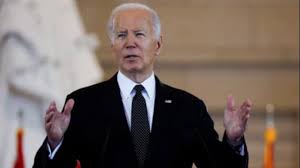
President Joe Biden stated on Wednesday that he would refrain from providing offensive weapons to Israel for an all-out assault on Rafah, the major Hamas stronghold in Gaza.
This decision was made out of concern for the well-being of the over 1 million civilians seeking shelter in Rafah. In an interview with CNN, Biden emphasized that the United States remains committed to Israel’s defense and will continue to supply defensive arms, such as the Iron Dome rocket interceptors. However, he made it clear that weapons and artillery shells used in offensive operations would not be supplied.
Over the years, the United States has been a significant provider of military aid to Israel, a commitment that has intensified following the Oct. 7 attack by Hamas, resulting in the deaths of approximately 1,200 individuals in Israel and the capture of around 250 by militants.
Biden’s recent comments and his decision to temporarily halt the shipment of heavy bombs to Israel highlight the growing differences between his administration and Israeli Prime Minister Benjamin Netanyahu’s government. While Biden acknowledged that Israel’s actions around Rafah have not yet crossed his red lines, he stressed the need for Israel to take greater measures to protect the lives of civilians in Gaza.
The shipment that was put on hold consisted of 1,800 2,000-pound (900-kilogram) bombs and 1,700 500-pound (225-kilogram) bombs. The concern of the United States primarily revolved around the larger explosives and their potential impact in densely populated urban areas.
Biden expressed his concern about the civilian casualties caused by these bombs and emphasized that he will not supply weapons historically used in dealing with Rafah or similar situations. However, he reassured that the United States remains committed to Israel’s security and will not abandon its support.
Israel’s ability to wage war in certain areas is being compromised as the United States has temporarily halted the delivery of high payload munitions.
Defense Secretary Lloyd Austin confirmed this delay, emphasizing that it is a precautionary measure taken in light of the unfolding events in Rafah. However, Austin reassured that the U.S. remains committed to ensuring Israel’s defense capabilities.
This development coincides with the Biden administration’s upcoming assessment of whether the recent airstrikes in Gaza and restrictions on aid delivery have violated international and U.S. laws aimed at protecting civilians during conflicts.
If a decision is made against Israel, it would increase pressure on President Biden to limit military support and funding to the Israeli military.
The pause in weapon shipments was authorized by President Biden himself, with the order relayed to the Pentagon last week. The White House National Security Council opted to keep this decision confidential until they had a clearer understanding of Israel’s military operations in Rafah and until President Biden could deliver a planned speech on Holocaust Remembrance Day.
Since April, the Biden administration has been reviewing future transfers of military assistance due to concerns over Netanyahu’s government potentially launching an invasion of Rafah, despite opposition from the White House. The decision to temporarily halt the shipment was made last week, and a final determination on whether to proceed with it at a later date has not yet been reached.
U.S. officials had refrained from providing comments on the suspended transfer for several days, while President Biden reiterated the unwavering support of the United States for Israel, even in times of disagreement. Israel’s ambassador to the United Nations, Gilad Erdan, expressed disappointment and frustration over the decision to halt the shipment, attributing it to political pressure on Biden from Congress, campus protests in the U.S., and the upcoming election.
The move was met with criticism from House Speaker Mike Johnson and Senate Republican Leader Mitch McConnell, who stated that they were only informed about the pause in military aid through media reports, despite assurances from the Biden administration that such delays were not being considered. In a letter, the Republicans urged Biden to promptly lift the hold, warning that it could embolden Israel’s adversaries, and to provide lawmakers with updates on the ongoing policy reviews.
Biden has been under scrutiny from some factions on the left and faced backlash from conservative critics who claim that he has tempered his backing for a crucial Middle Eastern ally. Senator Lindsey Graham, R-S.C., vehemently argued that withholding essential weapons for Israel during a time of significant threat would have severe consequences, emphasizing the urgency of supporting Israel in its defense efforts.