

















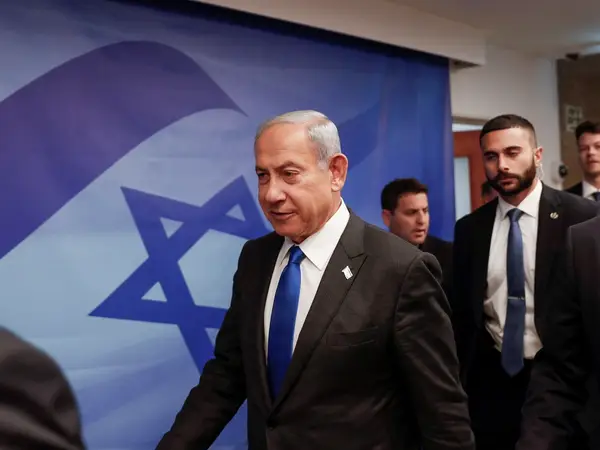
Israeli Prime Minister Benjamin Netanyahu asserted on Wednesday that his country would have the final say in determining whether and how to retaliate against Iran’s recent major air attack.
Despite calls for restraint from close allies, Israel has made it clear that it will respond to the unprecedented assault, leaving the region on edge after months of unrest related to the ongoing conflict in Gaza.
Israel’s allies have been urging caution, fearing that any aggressive response could lead to further escalation. These concerns were reiterated during visits by the British and German foreign ministers on Wednesday.
As diplomatic pressures mount, Iran’s president has issued a warning that even the slightest invasion of its territory would result in a significant and severe response. Meanwhile, violence has intensified between Israel and the Iran-backed Lebanese militant group Hezbollah, with rockets and drones being launched at northern Israel. The attack has left at least 14 Israeli soldiers injured, six of them seriously. In response, the Israeli military has targeted Hezbollah positions deep inside Lebanon.
During a Cabinet meeting, Netanyahu expressed gratitude for the support of the visiting foreign ministers but emphasized that Israel would ultimately decide how to respond, disregarding the various suggestions and advice from its allies. Despite the strong rhetoric, it is unlikely that Israel will directly attack Iran without the support of its key ally, the United States.
However, covert methods such as targeting senior Iranian commanders or Iran-backed groups in other countries, as well as launching cyber attacks, remain possible options for Israel.
President Joe Biden’s administration announced on Tuesday that it would impose new sanctions on Iran and has been working to rally global condemnation of the attack while urging all parties to reduce tensions. U.S. officials stated earlier this week that Biden assured Netanyahu that the U.S. would not be involved in any offensive actions against Iran.
Iran launched numerous missiles and drones at Israel over the weekend in response to an alleged Israeli attack on Iran’s Embassy compound in Syria on April 1, resulting in the deaths of 12 individuals, including two Iranian generals.
Israel claimed to have successfully intercepted nearly all the missiles and drones. A 7-year-old girl was injured in the attack, which did not result in any fatalities or significant damage.
The conflict between Israel and Iran has been ongoing for decades, but the recent attack marked the first direct military strike by Iran against Israel.
As tensions escalate, Israel’s allies have emphasized the importance of restraint. British Foreign Secretary David Cameron and German Foreign Minister Annalena Baerbock both called for calm during separate visits to the region.
Cameron acknowledged that Israel is considering action against Iran but expressed hope that it would be done in a strategic and measured manner to avoid further escalation. Baerbock reiterated Germany’s solidarity with Israel while urging the country to show restraint.
“It is crucial for everyone to act with caution and responsibility. This is not about giving in, but about demonstrating strength through prudent restraint,” she stated. “Israel has already demonstrated strength with its successful defense over the weekend.”
In statements reported by Iran’s official IRNA news agency, Raisi mentioned that the recent weekend attack was contained. He added that if Iran had intended to carry out a larger attack, the “Zionist regime” would have been completely wiped out.
Regional tensions have escalated following the October 7 attack on southern Israel by Hamas and Islamic Jihad, Palestinian militant groups supported by Iran. The attack resulted in the deaths of approximately 1,200 Israelis, with around 250 hostages taken. In response, Israel conducted a severe military campaign, resulting in the deaths of nearly 34,000 Palestinians, according to Gaza health officials. Most of the casualties are reported to be women and children, as combatants and civilians are not distinguished in the count.
Israel has mostly withdrawn its forces from Gaza after extensive offensives that left Gaza City and Khan Younis severely damaged. However, Israeli authorities have stated that the conflict is ongoing, with plans to deploy ground forces to Rafah, the southernmost city in Gaza, where over half of the territory’s 2.3 million inhabitants have sought shelter from the violence.
Hamas is still holding approximately 130 hostages, with a quarter of them presumed dead. International efforts to negotiate a cease-fire and secure the release of hostages have seen limited success.
Hezbollah, another key ally of Iran, has engaged in frequent exchanges of fire with Israel along the border since the conflict began, posing a risk of escalating into full-scale war. Iran-backed groups in Iraq and Syria have also carried out attacks, while the Iran-backed Houthi rebels in Yemen have targeted international shipping in the Red Sea, framing it as a blockade against Israel.