

















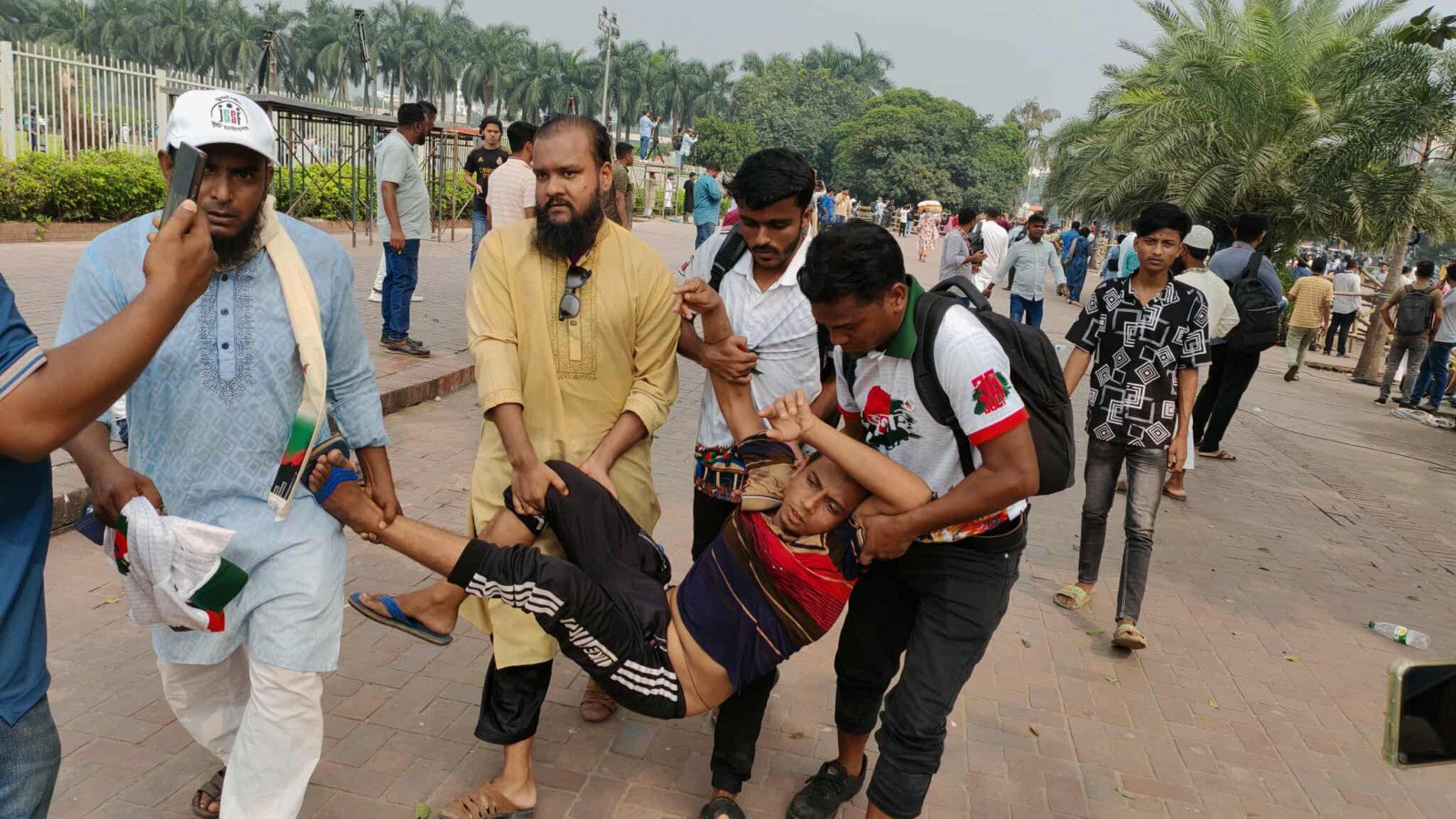
On Friday, October 17, the police in Bangladesh utilized teargas, batons, and stun grenades to disperse demonstrators who refused to vacate the vicinity of the National Parliament, amidst uncertainty regarding the signing of the July Charter.
Numerous protesters assembled at the designated stage for the signing ceremony, advocating for state acknowledgment, legal safeguards, and rehabilitation for individuals injured during the protests that led to the ousting of former Prime Minister Sheikh Hasina’s Awami League government in August 2024, as reported by bdnews24.com.
The protesters allegedly breached the Parliament grounds in the morning by climbing over the main gates and occupied seats reserved for guests while chanting slogans. Security forces attempted to prevent their entry, but confrontations ensued as tensions heightened.
Some demonstrators vandalized police vehicles and temporary shelters, while others engaged in clashes with soldiers and security personnel. Several individuals sustained injuries, according to news agency AP, which cited eyewitness accounts.
The altercation took place shortly after 1 PM at the South Plaza of the National Parliament Building, where the signing of the July Charter was planned. Police intervened to disperse the crowd using teargas, batons, and stun grenades.
The demonstrators identified themselves as participants in the uprising that removed Sheikh Hasina from power in July of the previous year. They condemned the new charter, asserting that it did not address their grievances despite the loss of their loved ones during the mass uprising.
Earlier on Thursday night, hundreds gathered near Gate 12 of the Parliament complex under the banner of July Martyrs’ Families and Injured Fighters. Protesters reportedly entered the premises and occupied guest seating while chanting slogans, as reported by Dhaka Tribune. The protests persisted outside the Parliament on Friday.
The interim government, led by Nobel Peace Prize laureate Muhammad Yunus, had extended an invitation to major political parties to sign the new charter on Friday as part of the nation’s political reform initiatives.
The “July National Charter,” which derives its name from the uprisings of July 2024, outlines proposals for constitutional changes, legal reforms, and the introduction of new legislation. This charter was drafted by a National Consensus Commission established by the Yunus administration, following discussions with significant political parties, with the exception of Hasina’s Awami League.
The Bangladesh Nationalist Party, under the leadership of former Prime Minister Khaleda Zia, along with eight allied parties, has expressed their intention to endorse the charter. Meanwhile, certain parties, such as the Islamist Jamaat-e-Islami, have yet to reach a decision, and the student-led National Citizen Party has opted not to engage in the process.
Sheikh Hasina, who was removed from power last August, is currently in exile in India and is facing trial in absentia for alleged crimes against humanity. Yunus has assured that elections will take place in February; however, there are ongoing concerns regarding the inclusivity of the electoral process in the absence of Hasina’s party and its allies.