


















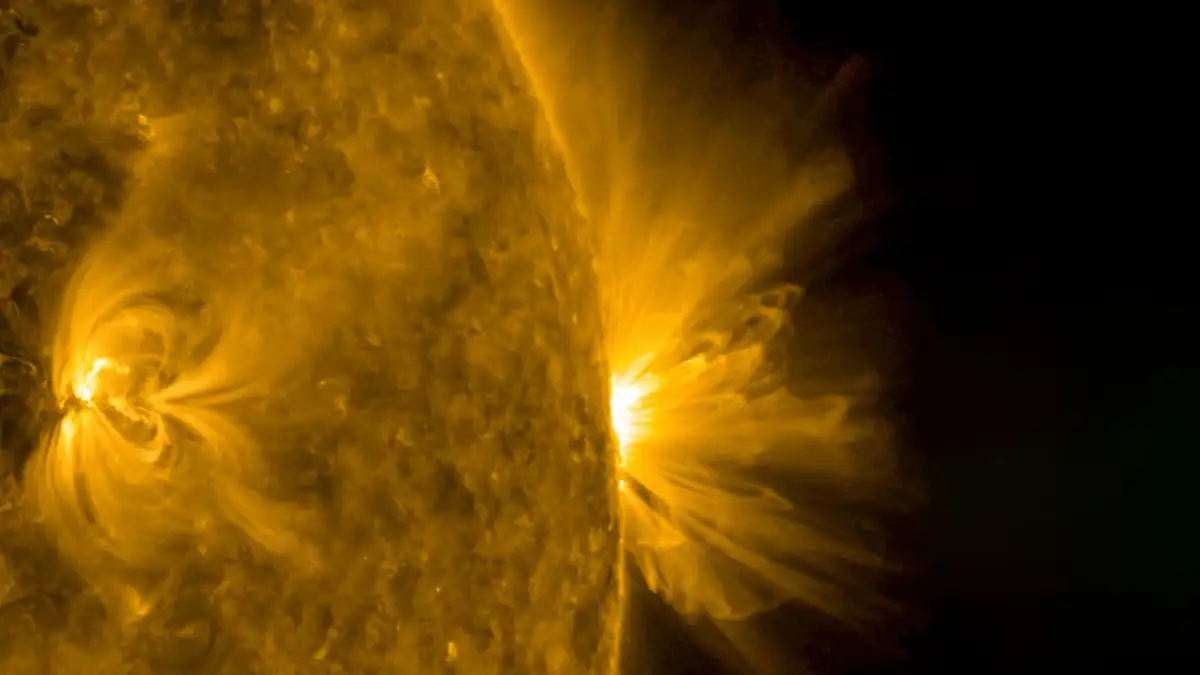
We may soon have the capability to predict destructive solar storms more than half a day in advance, thanks to a successful test conducted with the Solar Orbiter spacecraft and a new AI model named Surya.
The sun periodically releases massive bursts of plasma referred to as coronal mass ejections (CMEs). These eruptions can carry powerful magnetic fields that have the potential to disrupt satellites, power grids, and communication systems on Earth. Although telescopes and satellites can identify signs of CMEs, accurately predicting which ones pose a genuine threat has been challenging, as the risk is contingent upon the orientation of the magnetic fields within the ejections themselves.
In a recent advancement, researchers evaluated Surya using historical solar flare data and obtained remarkable results. The model demonstrated the ability to predict the occurrence of a solar flare within the subsequent day with 16% greater accuracy compared to traditional machine learning systems. Additionally, it produced visual representations of flares as they would be observed by an observatory up to two hours into the future, providing a potential early-warning window.
“By creating a foundational model trained on NASA’s heliophysics data, we are facilitating the analysis of the complexities of the sun’s behavior with unmatched speed and precision,” stated Kevin Murphy, chief science data officer at NASA Headquarters in Washington.
“This model enhances our understanding of how solar activity affects critical systems and technologies that we all depend on here on Earth,” he continued.
Initial trials further indicated that Surya could not only enhance flare strength predictions but also forecast the location of a flare’s eruption, marking another milestone in the field of space weather science. Such advance notice could be vital for safeguarding vulnerable infrastructure.
Solar storms and their associated risks
Solar flares represent powerful emissions of radiation from the sun’s surface, capable of causing extensive radio blackouts that disrupt both aviation and marine navigation. These flares are frequently accompanied by coronal mass ejections (CMEs), which propel enormous clouds of plasma into space. Upon reaching Earth, these CMEs can disturb the planet’s magnetic field and initiate significant geomagnetic storms, potentially leading to satellite disruptions, power supply failures, and interference with global communication systems.