


















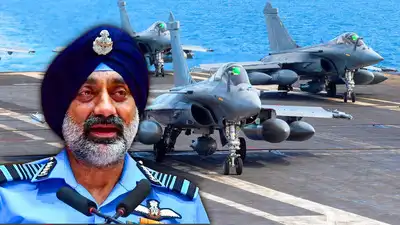
On Saturday, Vice Chief of the Air Staff, Air Marshal Narmdeshwar Tiwari, stated that Indian forces utilized fewer than 50 weapons during Operation Sindoor to target Pakistani military positions. This limited yet decisive action compelled Islamabad to seek a cessation of hostilities by midday on May 10.
During his address at the NDTV Defence Summit, Tiwari characterized the outcome as a notable success, emphasizing that “with less than 50 weapons, we were able to achieve conflict elimination.” He further remarked that the Indian Air Force (IAF) had established “complete domination” over Pakistan’s military following the assault on the night of May 9–10.
Tiwari, who was instrumental in the operation, highlighted that some of the targets destroyed during the strikes had not been targeted even in the 1971 war. “We made every weapon count, and that is a tacit acknowledgment of the capability of our planners and the personnel who executed the missions,” he stated.
The Air Marshal attributed the success of both offensive and defensive operations to the Integrated Air Command and Control System (IACCS), which enabled India to endure initial strikes and deliver what he termed a “hard-hitting reply” that encouraged Pakistan to de-escalate.
He also elaborated on New Delhi’s directives that guided the response: every action was required to be visibly punitive, the message conveyed should deter future attacks, and the armed forces were to be granted full operational freedom while preparing for the potential risk of escalation into a conventional war.
Operation Sindoor commenced on May 7 as a retaliation for the April 22 Pahalgam terror attack, targeting terrorist infrastructure in territories controlled by Pakistan. The strikes initiated four days of intense confrontations before both parties consented to cease military actions on May 10.