

















Cambodia and Thailand have reached an agreement for an “immediate and unconditional ceasefire” that will commence at midnight (1700 GMT) on Monday, in an effort to conclude their most intense conflict in over a decade, which has resulted in the displacement of more than 300,000 individuals over the past five days of fighting.
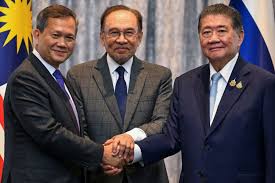
Following the mediation efforts of Malaysia, the chair of the ASEAN regional bloc, along with the United States and China, the leaders of both nations have consented to cease hostilities, resume direct communication, and create a framework to implement the ceasefire.
Malaysian Prime Minister Anwar Ibrahim remarked during a press conference, alongside the leaders of Thailand and Cambodia, that “this is a crucial initial step towards de-escalation and the re-establishment of peace and security,” after more than two hours of discussions at his residence in Putrajaya.
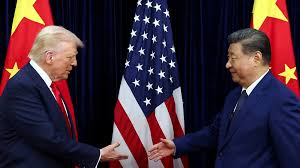
These peace negotiations were initiated after Anwar’s relentless efforts and phone calls from US President Donald Trump to both leaders over the weekend, during which he warned that continued violence would prevent him from signing trade agreements with them. Both nations currently face a 36% tariff on their exports to the United States, which is their largest market.
In a post on Truth Social on Monday, Trump expressed his congratulations to all involved and mentioned that he had spoken with officials from Thailand and Cambodia, authorizing his trade team to resume negotiations.
“By bringing an end to this War, we have preserved thousands of lives… I have successfully concluded numerous Wars in just six months — I take pride in being the President of PEACE!” Trump stated.
Long-standing disputes
The neighboring countries in Southeast Asia have been embroiled in disputes over border territories for decades and have maintained a state of conflict since the death of a Cambodian soldier during a skirmish in late May, which triggered a military buildup on both sides. This situation escalated into a full-blown diplomatic crisis that nearly caused the collapse of Thailand’s fragile coalition government.
They blame one another for initiating the conflict last week, which rapidly escalated from small arms fire to the deployment of heavy artillery and rockets at various locations along their 800-km (500-mile) land border. Thailand unexpectedly dispatched an F-16 fighter jet to conduct airstrikes just hours after the outbreak of hostilities.
At least 38 individuals have lost their lives in the conflict, predominantly civilians.
Thai acting Prime Minister Phumtham Wechayacha commended Trump for his efforts in promoting peace and stated that trade negotiations would commence from a favorable position.
“I expressed my heartfelt gratitude for what we have received from him, which has aided our nation in overcoming this crisis,” he informed reporters upon his return from Malaysia after his conversation with Trump.
“Following today, the situation is expected to de-escalate.”
The underlying tensions erupted last week when Thailand recalled its ambassador to Phnom Penh and expelled Cambodia’s envoy, following the injury of a second Thai soldier who lost a limb to a landmine that Bangkok claimed had been planted by Cambodian forces.
STORY CONTINUES BELOW THIS AD
Cambodia has vehemently denied these allegations, as well as Thai claims that it has targeted civilian sites, including schools and hospitals. It has accused Thailand of engaging in “unprovoked and premeditated military aggression.”
‘Decisive mediation’
Cambodian Prime Minister Hun Manet remarked that his Thai counterpart had played a constructive role and expressed his deep appreciation for Trump’s “decisive mediation” and China’s positive involvement.
“We concurred that the fighting will cease immediately,” he stated, adding that both parties could work towards rebuilding trust and confidence.
US Secretary of State Marco Rubio, in a statement, indicated that he and Trump anticipated that all parties would “fully honour their commitments to end this conflict.”
The conflict has left a lasting impact on border communities on both sides.
In Thailand’s Sisaket province, a residence was left in ruins, reduced to splintered wood and twisted beams after being hit by artillery fire from Cambodia. The roof had collapsed, windows were hanging by their frames, and power lines sagged over the structure.
Amidst the noise of sporadic artillery fire, residences and businesses remained closed, and a four-lane road was empty save for a handful of cars and military vehicles.
Numerous displaced individuals quietly queued for their evening meal at an evacuation center located approximately 40 km from the frontlines. Some children played with dogs, while others cleaned the dusty floor.
Fifty-four-year-old Nong Ngarmsri simply wished to return to her village.
“I want to go to my children who stayed behind,” she expressed. “I want the firing to stop so that I can return home.”