


















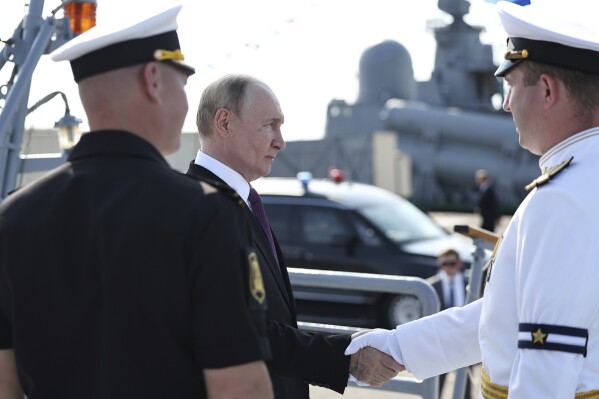
Russia reduced the scale of its Navy Day festivities on Sunday, citing security issues due to ongoing Ukrainian drone assaults that persistently challenge the Kremlin.
Russian officials canceled the customary warship parades that are usually held to honor the annual Navy Day events in St. Petersburg, the Kaliningrad region along the Baltic Sea, and the far-eastern port city of Vladivostok.
Kremlin spokesperson Dmitry Peskov addressed reporters’ inquiries regarding the cancellation of the parade in St. Petersburg, despite President Vladimir Putin’s presence in his hometown to inspect the navy headquarters, stating that “it’s related to the overall situation, security concerns, which take precedence.”
Throughout the night, Russian air defenses reportedly shot down 99 Ukrainian drones, as per the Russian Defence Ministry. It further asserted that an additional 51 drones were intercepted near St. Petersburg later that day. Local authorities reported that a woman sustained injuries from drone debris in the Lomonosov area.
In light of the drone threat, Pulkovo airport in St. Petersburg suspended numerous flights early on Sunday.
Putin visited the historic Admiralty headquarters in St. Petersburg to receive updates on naval maneuvers that concluded on Sunday. A total of 150 vessels from the Baltic Sea to the Pacific participated in the July Storm exercise.
In addition to pledging to enhance the navy’s training and construct more warships, Putin remarked that “the navy’s strike power and combat capability will elevate to a qualitatively new level.”
He also toured the Admiral Grigorovich frigate of the Baltic Fleet at the Kronstadt naval base, located just west of St. Petersburg, to commend its crew for successfully repelling a Ukrainian drone attack in the area earlier that day.
The decision to scale back the Navy Day celebrations underscores Moscow’s concerns regarding Ukraine’s extensive drone assaults throughout the nation.
In a series of military actions during the ongoing war, which has now entered its fourth year, Ukraine successfully sank multiple Russian warships in the Black Sea, significantly impairing Moscow’s naval capabilities and necessitating the redeployment of its fleet from Crimea, which is under Russian occupation, to Novorossiysk.
In a bold attack on June 1, codenamed “Spiderweb,” Ukraine deployed drones to strike various Russian air bases that were accommodating long-range bombers throughout Russia, extending from the Arctic Kola Peninsula to Siberia. These drones were launched from trucks discreetly positioned near the bases, catching the Russian military off guard in a significant embarrassment for the Kremlin.
The operation resulted in the destruction or damage of numerous bombers that Moscow had utilized to conduct aerial assaults on Ukraine, delivering a substantial morale boost to Kyiv at a moment when its forces, which are lacking in personnel and armament, are contending with Russian offensives along the extensive 1,000-kilometer (600-mile) front line.
On Sunday, Russia persisted in its assault on Ukraine with drone and missile strikes.
In Sumy, located in Ukraine’s northeast, a drone strike caused damage to civil infrastructure, including an administrative building and non-residential facilities, resulting in three individuals sustaining injuries. Additionally, in another part of the region, two men lost their lives due to an explosion from a land mine, while another woman was injured in a separate drone attack on a different community, as reported by the regional military administration.
French President Emmanuel Macron engaged in a phone conversation with Ukrainian President Volodymyr Zelenskyy on Sunday, subsequently stating on X that he reiterated France’s commitment to supporting Kyiv and pledged to increase pressure on Moscow to compel it to “agree to a ceasefire that facilitates discussions leading to a robust and enduring peace, with comprehensive European involvement.”