

















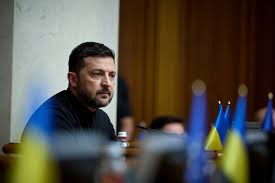
On Thursday, President Volodymyr Zelenskyy announced his intention to introduce a new anti-corruption bill to Ukraine’s Parliament, as part of an effort to alleviate tensions following the approval of amendments to corruption legislation that provoked public outrage and strong disapproval from the European Union.
Critics of the controversial law passed by lawmakers and endorsed by Zelenskyy earlier this week argued that it undermined the independence of Ukraine’s anti-corruption agencies by increasing government oversight of their operations.
Zelenskyy emphasized the need to expedite investigations, ensure more convictions, and eliminate “Russian influence” from the fight against corruption, although he did not provide specific instances of Russian involvement.
On Thursday, Zelenskyy unexpectedly revealed that he had prepared a new anti-corruption initiative that “ensures the genuine enhancement of the law and order framework in Ukraine.”
In a post on Telegram, Zelenskyy remarked, “The most crucial aspect is the availability of real tools, the absence of Russian connections, and the autonomy of the (watchdogs).”
After nearly three years of resisting Russia’s full-scale invasion, this announcement appeared to yield to recent pressures that risked diminishing public trust in Ukraine’s leadership. The protests have not called for Zelenskyy’s ousting, but they represent the first notable anti-government demonstrations since the onset of the conflict.
“It is vital that we uphold unity,” Zelenskyy asserted in his Telegram message.
The announcement also raised several unanswered questions. Zelenskyy had indicated on Wednesday that he met with the leaders of Ukraine’s principal anti-corruption and security agencies, giving them a two-week period to propose improvements to the graft law before he submitted another bill to Parliament.
Despite this commitment, additional street protests were planned for Thursday evening.
The recent announcement has left ambiguous whether Zelenskyy plans to annul the legislation he sanctioned earlier in the week following its passage by Parliament. He has not disclosed specifics regarding the proposed new legislation.
The turmoil arises at a challenging juncture in the ongoing war, which commenced on February 24, 2022. Russia’s larger military is intensifying its attempts to breach Ukraine’s front-line defenses and is heightening its bombardment of Ukrainian urban areas.
Ukraine is also confronted with uncertainty regarding the potential for additional military assistance from the United States and whether European commitments can compensate for any shortfall, with no resolution to the conflict in sight.
Delegations from both Russia and Ukraine convened in Istanbul for a third round of discussions within the span of three months on Wednesday. However, once again, the negotiations were brief and yielded no significant advancements.
Combating entrenched corruption is vital for Ukraine’s ambitions to join the European Union and to secure access to billions in Western aid during the conflict. This initiative also enjoys widespread public backing.
EU Enlargement Commissioner Marta Kos expressed her apprehension on Wednesday regarding the new legislation, labeling it as “a serious step back.” The Ukrainian branch of Transparency International condemned Parliament’s decision, asserting that it undermines one of the most critical reforms since what Ukraine refers to as its Revolution of Dignity in 2014 and erodes trust with international allies.
In the meantime, Russian aircraft dropped two powerful glide bombs on the heart of Kharkiv, Ukraine’s second-largest city, on Thursday morning, according to regional Governor Oleh Syniehubov. Authorities reported that at least 37 individuals were injured, including a 28-day-old infant, a 10-year-old girl, and two 17-year-olds.
The southern city of Odesa and Cherkasy in central Ukraine were also targeted overnight, as reported by officials. The drone and missile assaults on these cities resulted in 11 injuries, including a 9-year-old, and caused damage to historic sites and residential structures, according to authorities.
Ukraine has aimed to enhance its long-range drone strikes against Russia, utilizing local technology and production.
According to local authorities on Thursday, a nighttime drone assault by Ukraine on the Russian Black Sea resort of Sochi resulted in the deaths of two women and injuries to 11 others.
Officials reported that an oil depot was struck, although they did not provide further details.