


















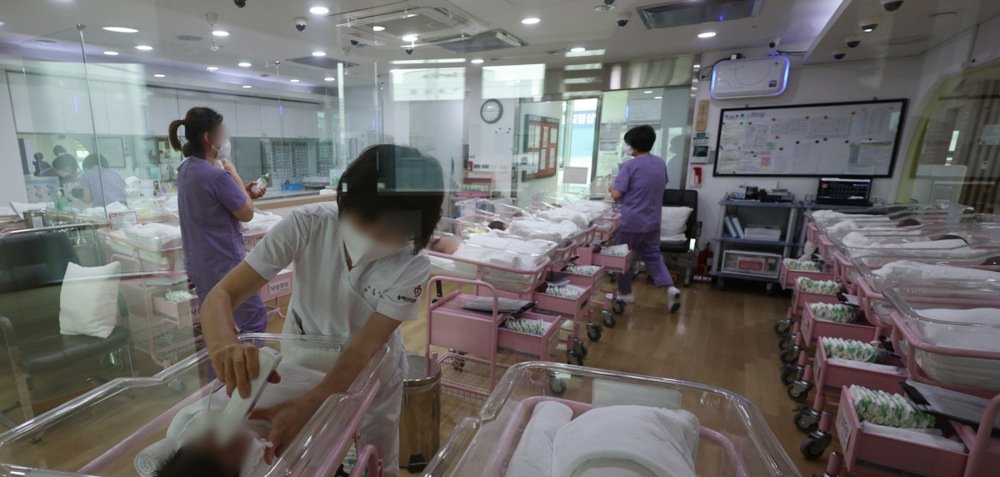
According to an official from a statistics agency who spoke with AFP on Wednesday, South Korea’s birth rate has risen at an unprecedented rate during the first five months of the year.
The nation holds one of the highest life expectancies globally while simultaneously having one of the lowest birth rates, which presents a considerable demographic challenge.
Seoul has allocated billions of dollars towards initiatives aimed at encouraging women to have more children and ensuring population stability.
Kang Hyun-young from Statistics Korea stated, “The number of newborns for the January–May period reached 106,048, marking a 6.9 percent increase, the highest growth rate since the commencement of such data collection in 1981.”
This increase follows South Korea’s first annual rise in births in over a decade, which was driven by a rise in marriages. In 2024, the number of infants born increased by 8,300, or 3.6%, totaling 238,300 compared to the previous year.
April, in particular, experienced a notable surge, with a year-on-year increase of 8.7 percent and a total of 20,717 births recorded that month.
The latest figures present a stark contrast to early 2024, when the number of newborns decreased by 2.7% from the previous year during the January to May period.
In May, the fertility rate, which indicates the average number of children a woman is expected to have in her lifetime, was recorded at 0.75.
To sustain the population of 51 million, the country requires a fertility rate of 2.1 children.
If current trends continue, the population is projected to nearly halve to 26.8 million by the year 2100, as per the Institute for Health Metrics and Evaluation at the University of Washington in Seattle.
Marriage correlation
The increase is attributed to “a rise in the number of women in their early 30s, resulting in an overall increase in marriages,” Kang informed AFP.
She further noted, “In South Korea, there exists a strong correlation between marriage and childbirth, which has contributed to the rise in births during the initial five months.”
In 2024, the nation experienced a 14.8 percent year-on-year rise in the number of marriages, with over 220,000 couples entering into matrimony.
Numerous government benefits aimed at assisting with child-rearing do not extend to parents who are not legally married.
Experts indicate that there are several factors contributing to the low birth rate, including high costs associated with raising children, expensive property prices, and a highly competitive society that makes securing well-paying jobs challenging.
Additionally, the dual responsibility faced by working mothers, who must handle the majority of household tasks and childcare while also pursuing their careers, is another significant factor, according to analysts.
To counteract this trend, the South Korean government provides financial subsidies, babysitting services, and assistance for infertility treatments.
Similarly, neighboring Japan is facing the same challenge – it has the second-oldest population in the world after Monaco, and the country’s relatively stringent immigration policies result in increasing labor shortages.