

















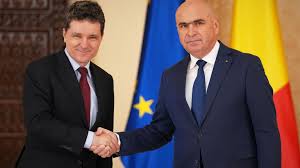
Romania’s President Nicusor Dan has put forward the nomination of Ilie Bolojan, the head of the National Liberal Party, following several weeks of coalition discussions. The primary challenge now facing the new government will be addressing the budget crisis.
Romania’s newly elected pro-Western President, Nicusor Dan, has appointed Ilie Bolojan, the leader of the pro-European National Liberal Party (PNL), as the next prime minister of the country. This announcement was made on Friday, signaling the conclusion of weeks of political instability that followed the annulled presidential elections in December.
The 56-year-old centre-right politician was previously serving as the president of the Senate and is recognized for his reform-oriented mindset and strong administrative skills. It is important to highlight that Bolojan had acted as president from February to May, during which time Dan triumphed over a hard-right rival in a contentious rerun of the presidential election.
This nomination occurs as Romania, a member of both the European Union and NATO, strives to resolve a prolonged political crisis that has affected the nation since the previous year. Bolojan’s appointment followed a new series of discussions between Dan and the PNL. The foremost challenge that Bolojan faces will be addressing the country’s budget crisis.
The budget crisis: Bolojan’s primary challenge
The 56-year-old leader is expected to confront Romania’s severe financial situation and work towards unifying the divided EU member state. The budget deficit was reported to be 9.3 percent at the end of last year, making it the highest in the European Union, according to AFP.
During a press conference last week, Bolojan remarked that Romania was “in a complicated situation,” indicating that the new government would need to implement “unpopular measures,” which may involve reducing public expenditure and increasing taxes.
In the meantime, political analyst Sergiu Miscoiu informed AFP that Bolojan is “the individual best positioned to undertake unpopular measures to address the serious budget crisis.” However, analysts also note that aside from a brief period as interim president, he possesses “no experience in national politics.”
In addition to this, the deep social divisions within the nation were highlighted by the controversies surrounding the presidential election. Cristian Andrei, a political consultant based in Bucharest, stated that the new government will encounter the challenge of achieving a long-term consensus regarding state reforms that have already been postponed.
“Currently, there exists only a contentious agreement on very short-term measures to address the economic and budget crisis,” the political consultant informed The Associated Press. “If these short-term measures incur a social cost, such as inflation, and are not accompanied by significant changes in policies and institutions, then a political crisis will overshadow the coming years and future elections,” he elaborated.
What lies ahead
Bolojan’s appointment now requires approval from the nation’s parliament. As reported by Euro News, his government is anticipated to include the leftist Social Democratic Party (PSD), the PNL, the reformist Save Romania Union party, and the smaller ethnic Hungarian UDMR party.
Prior to his nomination, the PSD advocated for a power-sharing agreement that would facilitate a rotation of the prime ministerial position. After being nominated for the role of prime minister, Bolojan expressed that he is “fully aware of the significant responsibility” that the position entails and recognized that it “will not be an easy task.”
“I will focus on three priorities: restoring order to the nation’s finances, striving for good governance that fosters development in Romania, and … demonstrating proper respect for the Romanian populace,” he added.
Although far-right parties recently secured a third of the parliamentary seats, they were excluded from discussions to form a new government. Defeated presidential candidate George Simion described this exclusion as “a disgrace and an insult.” Meanwhile, the European Union has expressed concerns regarding the rise of Eurosceptic parties in NATO member Romania, which oppose the provision of military aid to Ukraine.