


















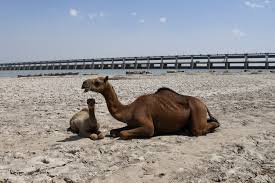
Pakistan is experiencing severe drought conditions. The recent decision by India to halt the Indus Waters Treaty has triggered a crisis in the neighboring country — the water flow from the Indus River System has decreased by nearly 20 percent. This reduction has adversely affected the kharif crop season, which will have detrimental effects on the struggling nation’s economy.
Pakistan is experiencing severe water shortages, quite literally.
In the aftermath of the Pahalgam terror attack on April 22, which resulted in the deaths of 26 individuals, India made the difficult yet justified decision to suspend the Indus Waters Treaty. Foreign Secretary Vikram Misri announced that the treaty would remain ‘in abeyance’ until Pakistan took ‘credible and irrevocable’ actions to halt its support for cross-border terrorism.
At that time, many speculated whether this action would adversely affect Pakistan. The repercussions of India’s decision are now evident and being felt in the neighboring nation, as river water levels have reached ‘dead’ status, jeopardizing Pakistan’s kharif season.
Water levels in Pakistan have reached critical lows.
Official statistics indicate that the total water released from the Indus River System to Pakistan is nearly 20 percent lower compared to the same date last year. In the Sindh region, the water flow was recorded at 1,33,000 cusecs, down from 1,70,000 cusecs the previous year. Likewise, in Punjab, the water flow was at 1,10,500 cusecs, a 20 percent decrease from 1,30,800 cusecs on June 20 of the previous year.
In the Khyber Pakhtunkhwa region, the water flow has also decreased to 2,600 cusecs on June 20, down from 2,900 cusecs on the same date last year.
This situation has persisted since India suspended the Indus Waters Treaty. For example, on June 16, the ‘Daily Water Situation’ report published by Pakistan’s Indus River System Authority (IRSA) indicated that the total water released to Sindh province was 1.33 lakh cusecs, compared to 1.6 lakh on the same day last year, reflecting a decline of 16.87 percent.
Moreover, the water levels in Pakistan’s two primary reservoirs — Tarbela on the Indus and Mangla on the Jhelum — have fallen to dead storage.
Impact on Pakistan
What does it truly signify for the rivers of Pakistan to reach dead storage levels, and what consequences will this have for the nation? Dead storage levels refer to the volume of water that is retained below the lowest outlet level, rendering it essentially unusable for standard water supply needs. This limitation affects its applicability for both irrigation and drinking purposes.
The water in Pakistan’s reservoirs reaching dead storage levels will profoundly influence the kharif (summer crops) sowing season. Indeed, a report from India Today indicates that kharif farming has already experienced a decline of over 20 percent due to receiving 1.14 lakh cusecs of water compared to 1.43 lakh cusecs per day last year.
The output of kharif crops, particularly cotton and maize, has decreased by more than 30 percent and 15 percent in Pakistan, respectively. Additionally, wheat production has fallen by approximately nine percent as a result of the water scarcity in the country.
Consequently, this will adversely affect an already struggling Pakistani economy that is heavily dependent on agriculture. The agricultural sector in Pakistan accounts for 23 percent of the national income, and with the decline in kharif crop production, it will negatively impact Pakistan’s financial standing.
Experts suggest that the situation may improve with the arrival of the monsoon rains; however, until that time, Pakistan will remain in a state of thirst.
Parched Pakistan reaches out to India
Faced with a looming water crisis, Pakistan has sent not one but four letters to India, requesting the reinstatement of the Indus Waters Treaty, which was originally signed in 1960.
Various news reports citing sources have revealed that Syed Ali Murtaza, the secretary of Pakistan’s Ministry of Water Resources, has penned four letters to India, urging it to reconsider its decision to halt the Indus Waters Treaty.
The sources indicate that India’s Jal Shakti Ministry has forwarded all four letters from Pakistan to the Ministry of External Affairs. The situation is so severe that Pakistan has also appealed to the World Bank, which facilitated the agreement, to intervene in this matter. Nevertheless, the World Bank declined to involve itself in the issue.
Importance of the Indus Waters Treaty and India’s suspension of it
Pakistan’s water challenges emerged when India declared that it was suspending the Indus Waters Treaty in reaction to the Pahalgam terror attack. The treaty, signed in September 1960, regulated the distribution of water from the Indus River system between the two nations.
According to the agreement, India was allocated rights to the Eastern Rivers: the Ravi, Beas, and Sutlej, while Pakistan was assigned the Western Rivers: the Indus, Jhelum, and Chenab.
Approximately 70 percent of the water in the system was designated for Pakistan. Under the IWT, India was required to permit the flow of the Western Rivers to Pakistan, with restricted rights for agricultural, transport, and hydroelectric projects that do not impede river flow.
New Delhi’s choice to suspend the treaty provoked significant outrage in Pakistan, with Islamabad characterizing the move as “an act of war,” asserting that it was ready to respond “with full force across the complete spectrum of national power.” Furthermore, on June 17, Pakistan People’s Party (PPP) leader Bilawal Bhutto Zardari was reported by German broadcaster DW Urdu stating that any effort by India to obstruct Pakistan’s water supply would be perceived as an existential threat, leaving Pakistan with no alternative but to resort to war.
In the wake of India’s decision to suspend the treaty, New Delhi is also undertaking a feasibility study for the construction of a 113 km-long canal to redirect surplus flow from the three western rivers of the Indus water system to Punjab, Haryana, and Rajasthan.
With contributions from agencies