

















For the first time, the Canadian Security Intelligence Service (CSIS) has formally acknowledged that Khalistani extremists are utilizing Canadian territory as a foundation to advance their agenda, gather funds, and orchestrate violent actions, mainly targeting India.
Days after Prime Minister Narendra Modi participated in the G7 Summit in Canada at the invitation of Canadian Prime Minister Mark Carney, Canada’s leading intelligence agency has made a noteworthy announcement.
For the first time, the Canadian Security Intelligence Service (CSIS) has officially acknowledged that Khalistani extremists are utilizing Canadian soil as a platform to advance their agenda, gather funds, and orchestrate violent actions — primarily directed against India.
“Khalistani extremists persist in using Canada as a foundation for the promotion, fundraising, or planning of violence mainly in India,” the report explicitly states.
This revelation, elaborated in CSIS’s 2024 annual report, provides official confirmation of India’s long-held apprehensions regarding the existence and activities of pro-Khalistan factions operating from Canada.
“Since the mid-1980s, the threat of politically motivated violent extremism (PMVE) in Canada has primarily manifested through Canada-based Khalistani extremists (CBKEs) who seek to employ and endorse violent methods to establish an independent nation-state known as Khalistan, predominantly within Punjab, India,” the report articulates.
The CSIS report outlines the actions of a small faction of Canada-based Khalistani extremists (CBKEs) who persist in pursuing their separatist objectives through violent means.
“A small group of individuals is classified as Khalistani extremists due to their continued use of Canada as a base for the promotion, fundraising, or planning of violence primarily in India. Specifically, the real and perceived Khalistani extremism emerging from Canada continues to fuel Indian foreign interference activities within Canada,” the report further elaborated.
While CSIS clearly differentiates between violent extremists and those involved in peaceful advocacy for Khalistan, it emphasizes that this minority group exploits Canadian territory as a refuge to support and coordinate attacks aimed at India.
India-Canada tensions
The report elucidates various contentious matters that have exacerbated tensions between Ottawa and New Delhi since the assassination of Hardeep Singh Nijjar, a designated Khalistani terrorist, in British Columbia in 2023.
Under the leadership of Justin Trudeau, Canadian officials have alleged Indian involvement in Nijjar’s murder, a claim that India has dismissed as “absurd,” while accusing Canada of harboring anti-India factions.
The CSIS report further illuminates India’s purported attempts to counter the Khalistan movement through what it describes as foreign interference activities within Canada, including efforts to target individuals in North America.
Timing of the report
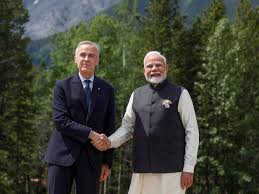
The report was released concurrently with a recent high-profile meeting between PM Carney and PM Modi during the G7 Summit in Alberta, where both leaders concurred on the necessity to restore full diplomatic relations by appointing new high commissioners and resuming stalled trade discussions, indicating a shared interest in stabilizing bilateral relations.
Carney defended his choice to invite PM Modi despite criticism from Sikh advocacy groups and certain Canadian lawmakers, emphasizing India’s global economic significance and the importance of maintaining open diplomatic channels.
In a broader context, CSIS identifies politically motivated violent extremism as a significant national security concern, with Khalistani extremism underscored as a primary example.
Although no Khalistani attacks took place on Canadian soil in 2024, the involvement of Canada-based extremists in violent activities abroad continues to pose a considerable challenge for national security agencies.