

















In a recent development, US President Donald Trump has intensified his demands on Ukraine, requesting a response by the end of the week regarding several proposals. These proposals include the acknowledgment of Ukrainian territory seized by Russia as part of efforts to conclude the conflict, as reported.
President Donald Trump is seeking Ukraine’s feedback on several U.S. proposals aimed at resolving the ongoing conflict with Russia, as reported this week.
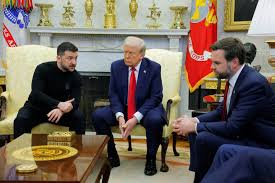
This demand from Trump represents a growing trend of U.S. pressure on Ukraine. Despite Russia’s rejection of all three ceasefire proposals endorsed by the U.S. and its violation of a ceasefire it declared unilaterally, the Trump administration has refrained from exerting any pressure on Russia. Instead, Trump has focused on pressuring Ukraine, which has included personal criticisms of its leader, Volodymyr Zelenskyy, and support for proposals that align closely with Russia’s demands.
According to The Wall Street Journal, Trump is expecting Ukraine to respond to these proposals during a meeting involving U.S., European, and Ukrainian officials scheduled in London later this week.
If enacted, the U.S. proposals would effectively grant Russia a significant advantage and meet many of its ambitious goals, as indicated in the report.
Among the proposals Trump is urging Ukraine to consider is the U.S. acknowledgment of Crimea and other territories that Russia has seized and annexed, as reported by The Journal.
Thus far, Ukraine has maintained that recognizing and formally surrendering Crimea and other territories taken by Russia is a non-negotiable boundary it will not cross.
Russia invaded Ukraine in 2014, seizing and subsequently annexing Crimea. Following a second invasion that same year, Russia annexed four additional regions: Kherson, Zaporizhzhia, Luhansk, and Donetsk. Although Russia exerts control over significant portions of these regions, active conflict continues, and it does not fully control any of them.
Historically, under the administrations of Barack Obama, Joe Biden, and even during Trump’s first term, the United States has consistently asserted that Russia’s occupation and annexation of Crimea is illegal. However, it seems that Trump may be poised to alter this longstanding position.
Additional elements of Trump’s proposals involve officially prohibiting Ukraine’s accession to NATO and establishing U.S. oversight over essential infrastructure within Ukraine, as reported by The Journal.
Among the key infrastructures, Trump aims for the United States to assume control of the Zaporizhzhia nuclear power plant, which is the largest in Europe.
Once under U.S. management, this facility would provide electricity to both Ukrainian territories controlled by Ukraine and those under Russian control, according to the publication.
While Trump is open to acknowledging Russia’s occupation of Crimea, the report indicates that the U.S. proposal does not extend to recognizing the four Ukrainian regions annexed by Russia in 2022, nor does it demand that Russia withdraw from those areas.
This implies that Trump has effectively endorsed the Russian occupation and annexation of Kherson, Zaporizhzhia, Luhansk, and Donetsk as part of the current proposal.
In a minor concession that holds little significance, Trump has agreed not to impose any limitations on the size of Ukraine’s post-war military or the presence of European troops on Ukrainian territory, as noted by the newspaper.
If Trump succeeds in compelling Ukraine to accept his proposals, it would essentially signify a victory for Russia, achieving many of its objectives.
Should Trump’s proposals be accepted, Russia would gain recognition for the annexation of Crimea; de facto acknowledgment of the annexation of Kherson, Zaporizhzhia, Luhansk, and Donetsk; a weakening of Ukraine due to the loss of control over the Zaporizhzhia power plant; and a cessation of hostilities along the current frontlines.
It is clear that Russia’s aim to replace Zelenskyy with a puppet government and undermine Ukraine’s national identity will ultimately fail. However, analysts have consistently argued that any ceasefire established in this conflict would likely be exploited by Russian President Vladimir Putin to rearm for a future invasion, similar to how the 2022 invasion followed the initial incursion in 2014 and the prolonged Russia-supported insurgency in eastern Ukraine.
For Ukraine, the agreement offers minimal benefits, lacking any security assurances.
The only potential advantage for Ukraine within this agreement is Trump’s endorsement of a European military presence in Ukraine to oversee any ceasefire established between Ukraine and Russia.