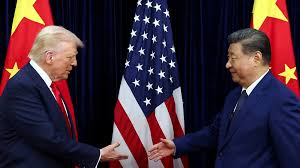



















China has strongly criticized the United States, alleging that it is portraying itself as a victim in the current trade conflict. The Chinese government has called on Washington to “stop whining,” asserting that it has previously benefited without cost from globalization.
China has issued a strong condemnation of the United States, accusing it of adopting a victim mentality in the ongoing trade conflict and urging Washington to “stop whining” after having “enjoyed a free ride on the globalization train.”
These remarks were made following Beijing’s announcement of better-than-expected economic growth, even as the nation prepares for the repercussions of tariffs imposed by former President Donald Trump.
Although the recent escalation of reciprocal tariff increases seems to have paused, tensions between the two largest economies in the world remain elevated, with Beijing reiterating its stance that it is “not afraid to fight.”
According to a report by The Guardian, China Daily — the English-language publication of the ruling Chinese Communist Party (CCP) — released a pointed editorial on Tuesday evening, dismissing Trump’s repeated assertions that the US has been “ripped off” by China.
The state-controlled outlet characterized these claims as misleading rhetoric intended to mislead the American public, referring to them as “hoodwinking.”
“The US is not being ripped off by anyone,” the editorial stated, as quoted by The Guardian.
“The issue lies in the fact that the US has been living beyond its means for decades. It consumes more than it produces, has outsourced its manufacturing, and borrowed money to maintain a higher standard of living than its productivity warrants. Instead of being ‘cheated,’ the US has been enjoying a free ride on the globalization train,” the editorial continued.
“The US should cease its complaints about being a victim in global trade and put an end to its erratic and harmful behavior,” it further asserted.
The Chinese Communist Party has remained steadfast against Trump’s calls for new trade negotiations.
On Wednesday, Beijing announced a change in its trade leadership, appointing Li Chenggang as the new international trade negotiator and vice commerce minister, succeeding veteran Wang Shouwen. No official explanation was provided for this change, but it coincides with a broader government reshuffle, as reported by The Guardian.
In response to the ongoing impasse, White House spokesperson Karoline Leavitt stated on Tuesday that “the ball is in China’s court.”
“China must reach an agreement with us; we are not obligated to negotiate with them,” Leavitt was quoted as saying in her statement.
“There is no distinction between China and any other nation, except for its significantly larger size,” she further remarked.
On Wednesday, China’s foreign ministry countered this assertion, emphasizing that the United States initiated the trade conflict and that Beijing has consistently expressed its desire to avoid confrontation, while also indicating it is prepared to stand firm.
“If the US genuinely seeks to address the issue through dialogue and negotiation, it must cease its extreme pressure tactics, stop issuing threats and engaging in blackmail, and engage with China on the principles of equality, respect, and mutual benefit,” Lin Jian, a spokesperson for the foreign ministry, was quoted by The Guardian.
Experts and officials caution that the trade war is poised to adversely affect both economies, particularly as China grapples with challenges in its post-pandemic recovery, including weak consumer spending and elevated youth unemployment rates.
Despite these challenges, Beijing reported on Wednesday that its economic performance exceeded expectations, largely driven by exporters eager to dispatch goods to the US before impending tariffs take effect.
According to data from China’s National Bureau of Statistics, the economy expanded by 5.4% in the first quarter, surpassing analysts’ predictions.
However, Sheng Laiyun, a senior official at the statistics bureau, cautioned The Guardian that the US tariffs “will exert certain pressures on our country’s foreign trade and economy.”
Chinese President Xi Jinping is currently on a tour of Asian nations, a journey that, although planned prior to the tariff conflict, has enhanced Beijing’s efforts to strengthen trade relations with other countries.
China is prepared to collaborate with Malaysia and other ASEAN nations, in line with the ongoing trends of peace and historical development. This partnership aims to counteract the subtle influences of geopolitics and tribalism, challenge unilateralism and protectionism, and establish a high-level strategic alliance between China and Malaysia that fosters a closely-knit community with a shared future, as stated by Xi in an editorial released prior to his visit to Malaysia on Wednesday.
While tariffs remain at 145% on Chinese imports to the United States and 125% on American goods entering China, both nations are intensifying their trade conflict through alternative strategies.
Reports indicate that Beijing has instructed airlines to suspend the acquisition of US aircraft components, including those from Boeing, and is considering support for carriers that lease Boeing jets. Approximately 10 Boeing 737 Max aircraft are scheduled for delivery to Chinese airlines, but only those deliveries approved before the implementation of reciprocal tariffs may proceed, according to Bloomberg.
Additionally, Hong Kong Post has announced it will cease accepting packages destined for the US, citing “unreasonable and bullying acts” by the United States, although mail containing only documents will remain unaffected. While Hong Kong is subject to the tariffs imposed by mainland China, it has not enacted its own tariffs.
In the meantime, Trump has initiated investigations into the possibility of new tariffs on pharmaceuticals, semiconductors, and critical minerals—sectors that would significantly impact key US trading partners.
China, which holds a dominant position in rare-earth supply chains, has already enacted export controls on several of these essential elements.