














The election was largely regarded as a preliminary referendum on Trump’s presidency. It evolved into the most costly judicial race in U.S. history, with expenditures exceeding $90 million from the candidates, state parties, and external organizations, as reported by New York University’s Brennan Center.
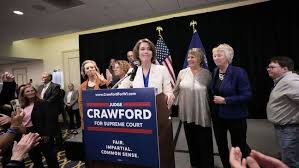
Wisconsin voters elected Susan Crawford to the state Supreme Court on Tuesday, preserving the court’s 4-3 liberal majority, which represented a setback for President Donald Trump and his wealthy supporter Elon Musk, who had endorsed her conservative opponent.
The election was perceived as an early assessment of Trump’s presidency, and it became the most expensive judicial race in U.S. history, with over $90 million spent by the candidates, state parties, and external organizations, as reported by New York University’s Brennan Center.
Crawford, who serves as a county judge, triumphed over conservative Brad Schimel, a former Republican state attorney general and fellow county judge, who conceded both in a phone call to Crawford and in a speech to his supporters. With approximately 88% of the votes counted, Crawford led by 9 points, translating to a margin of about 191,000 votes.
Given the stakes for the court’s composition, Musk and affiliated political groups invested over $21 million to back Schimel. Crawford characterized the election as a battle between herself and the out-of-state billionaire.
“As a young girl in Chippewa Falls, I never imagined I would be standing up against the richest man in the world for justice in Wisconsin. And we won!” Crawford declared to her supporters during a celebration in Madison, the state capital.
Trump refrained from commenting on the Supreme Court election in a social media post, instead choosing to celebrate the success of a different Wisconsin ballot measure that mandates stricter voter identification requirements.
National Democrats hailed the Wisconsin outcome as a significant step toward their objective of regaining control of the House of Representatives in 2026.
“Tonight, the people of Wisconsin have clearly rejected the influence of Elon Musk, Donald Trump, and billionaire special interests,” stated Ken Martin, chair of the Democratic National Committee.
Voters in Wisconsin seemed to recognize that the election had implications extending beyond their state.
“Prioritizing the needs of ordinary citizens is more crucial than catering to those who support Elon Musk or other billionaires,” stated West Roberts, a 26-year-old voter from Crawford, during a conversation in Madison just before the polls closed on Tuesday evening.
In Genesee, retiree Gary Christenson expressed his intention to vote for Schimel. “If a liberal takes office, they will persist in undermining Trump’s initiatives aimed at reducing the size of government,” he remarked.
Florida Republicans Achieve Success
In a further indication of Trump’s influence, two Florida Republicans secured victories in special elections to fill U.S. House vacancies resulting from Trump’s cabinet appointments.
These wins have solidified a Republican majority in the House, now standing at 220-213.
The Republican Party was anticipated to retain both seats with relative ease, prompting interest in how closely the Democrats might contest them.
In one district encompassing Daytona Beach, Republican state Senator Randy Fine triumphed over Democrat Josh Weil, a public school teacher. Fine led by approximately 14 points, following Michael Waltz’s previous victory in the seat by 33 points in November.
In the other contest near Pensacola, Republican state Chief Financial Officer Jimmy Patronis defeated Democrat Gay Valimont, an advocate for gun violence prevention. Patronis was ahead by nearly 15 points, after Valimont had previously lost the seat to Matt Gaetz, who was once Trump’s nominee for Attorney General, by 32 points in November.
Key State in the Political Landscape
Wisconsin’s highest court is expected to deliver significant rulings on voting rights and election regulations in advance of the 2026 midterms and the 2028 presidential election, as the state is anticipated to remain a pivotal battleground. Trump narrowly won Wisconsin in November by less than one percentage point, marking the tightest margin of any state.
The court is also set to determine whether abortion rights will continue to be legally protected statewide and may reconsider a Republican-supported law that significantly limited collective bargaining rights for most public employee unions.
Musk, who is leading the so-called Department of Government Efficiency, is at the forefront of Trump’s unprecedented federal cost-cutting initiative, making him a pivotal figure in the electoral race. During a rally on Sunday night, his primary super PAC distributed $1 million checks to two attendees.
The CEO of Tesla, having invested over $250 million to support Trump’s election bid in November, also incentivized volunteers by offering $20 for each voter they successfully recruited prior to the election. Additionally, on Tuesday, he proposed a $100 reward for voters who would upload a photo of someone holding a picture of Schimel while giving a thumbs-up.
Musk has expressed that “the future of Western civilization” is in jeopardy, as the court may soon make decisions regarding redistricting, which involves the alteration of political boundaries. Such changes could influence the power dynamics between Republicans and Democrats in the closely contested U.S. House of Representatives, thereby impacting Trump’s governance.
Crawford’s campaign has received significant support from wealthy Democratic donors, including philanthropist George Soros and Illinois Governor J.B. Pritzker.