


















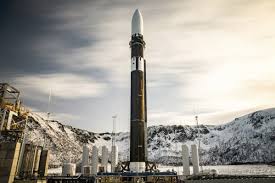
The Spectrum rocket, created by the German start-up Isar Aerospace, emitted smoke from its sides before plummeting back to Earth in a dramatic explosion shortly after its launch from Norway’s Andoya Spaceport in the Arctic, as shown in a live broadcast on YouTube.
A rocket developed by a private European aerospace firm was launched from Norway on Sunday but crashed into the ocean just 30 seconds later.
Despite the brief duration of the test flight, Isar Aerospace announced that it successfully conducted the inaugural test flight of its orbital launch vehicle by launching the Spectrum rocket from Andøya Island in northern Norway.
The Spectrum, measuring 28 meters (92 feet) in length, is a two-stage launch vehicle engineered to deploy small and medium-sized satellites into orbit. The rocket lifted off from the launch pad at 12:30 p.m. (1030 GMT) on Sunday and flew for approximately half a minute before the flight was terminated, according to Isar.
“This provided the company with a significant amount of flight data and experience to utilize in future missions,” Isar stated. “After the flight was terminated at T+30 seconds, the launch vehicle descended into the sea in a controlled manner.”
Footage from the launch captures the rocket ascending from the pad, soaring into the sky, and subsequently crashing into the ocean in a dramatic explosion.
The launch was influenced by various factors, including weather conditions and safety protocols. Sunday’s launch followed a week of adverse weather, which included a canceled launch on March 24 due to unfavorable winds and another postponement on Saturday because of weather restrictions.
“Our first test flight met all our expectations and was a significant success,” said Daniel Metzler, Isar’s CEO and co-founder, in the statement. “We achieved a clean liftoff, 30 seconds of flight, and successfully validated our Flight Termination System.”
The company had largely dismissed the likelihood of the rocket reaching orbit during its first complete flight, indicating that a 30-second flight would be considered a success. Isar Aerospace aims to gather as much data and experience as possible during this initial integrated test of all systems on its in-house developed launch vehicle.
Isar Aerospace operates independently from the European Space Agency (ESA), which receives funding from its 23 member nations.
“Achieving liftoff is a significant milestone, and a wealth of data has already been gathered. I am confident that @isaraerospace will gain valuable insights,” stated ESA Director General Josef Aschbacher on X. “Launching rockets is a challenging endeavor. Persist and advance with even greater determination!”
For many years, ESA has been successfully launching rockets and satellites into orbit, primarily from French Guiana, an overseas region of France located in South America, as well as from Cape Canaveral in Florida.