


















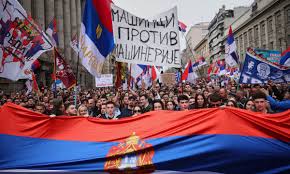
On Saturday, tens of thousands of demonstrators gathered in Belgrade, the capital of Serbia, marking what may be the largest event in a series of anti-corruption protests that have significantly impacted the Balkan nation in recent months.
On Saturday, at least 107,000 individuals convened in Belgrade, the capital of Serbia, to express their opposition to what they characterize as governmental corruption, as reported by the interior minister.
The ministry indicated that the rally, which commenced around noon, proceeded without any significant incidents and reiterated the government’s appeal for tranquility. The event was characterized by the resounding sounds of whistles, drums, and vuvuzelas, with some participants displaying banners proclaiming, “He’s Finished!” The crowd also chanted “Pump it Up,” a phrase that gained popularity during four months of student-led protests.
“I anticipate that this will undermine his authority and make Vucic aware that he no longer has the support of the people,” stated Milenko Kovacevic, one of the attendees.
This demonstration, likely the largest anti-government protest in Serbia’s history, follows more than four months of protests against corruption, representing a significant challenge to President Aleksandar Vucic’s 13-year tenure.
The protests were ignited by the tragic deaths of 15 individuals due to a roof collapse at a railway station, which prompted allegations of extensive corruption and negligence. However, the presence of Vucic’s supporters in the capital raised concerns about the possibility of confrontations.
Dejan Simic, a protester, remarked that the substantial rally is merely the beginning of a movement toward a more democratic Serbia. “This is just the start of the end, a process that I hope will conclude soon,” he expressed.
In messages shared on social media, students encouraged participants to behave “in a calm and responsible manner” during the rally.
“The aim of this movement is not to invade institutions or to attack those with differing opinions,” one statement asserted.
“This movement must not be exploited.”
Vucic asserts that the West is supporting the ongoing protests. He has dismissed previous suggestions for a transitional government intended to facilitate early elections. Concerns about potential violence have escalated as Vucic’s supporters have established a presence in central Belgrade, directly outside his headquarters. This group includes former members of a notorious paramilitary unit linked to the assassination of Serbia’s first democratic Prime Minister, Zoran Djindjic, in 2003, as well as soccer hooligans known for their propensity for violence.
On Saturday, private N1 television aired footage showing numerous young men wearing baseball caps entering the pro-Vucic encampment.
Vucic has alleged that Western intelligence agencies are orchestrating the nearly daily protests led by students, aiming to remove him from office. However, he has not provided any supporting evidence for these assertions.
In contrast, previous student-led demonstrations in other Serbian cities have remained peaceful while attracting large crowds.