

















Rwanda’s President Paul Kagame expressed his agreement with the U.S. government regarding the necessity of a ceasefire in eastern Congo; however, he did not indicate any willingness to comply with demands for the withdrawal of Rwandan troops and the M23 rebels they support from Goma.
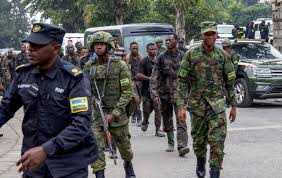
The M23 rebels entered Goma, the largest city in eastern Congo, on Monday, marking the most significant escalation in a protracted conflict in over ten years. This surge in violence has overwhelmed hospitals, which are now treating numerous patients suffering from gunshot, mortar, and shrapnel injuries.
On Tuesday, the U.S. called upon the United Nations Security Council to contemplate unspecified actions to curb the rebel offensive, which has displaced tens of thousands of individuals from their homes. The council possesses the authority to implement sanctions.
In Goma, the capital of North Kivu province in the Democratic Republic of Congo (DRC), reports indicated that shops and residences had been looted. However, following several days of intense conflict, the city was mostly quiet on Wednesday, with only sporadic gunfire reported by residents.
Kagame noted on X on Wednesday that he had a constructive discussion with Secretary of State Marco Rubio about the importance of achieving a ceasefire in Eastern DRC and addressing the underlying causes of the conflict definitively. Rubio conveyed to Kagame that Washington was “deeply troubled” by the recent escalation in the three-decade-long conflict, which is deeply intertwined with the aftermath of the Rwandan genocide and the competition for control over Congo’s mineral wealth.
Congo and the head of U.N. peacekeeping have reported the presence of Rwandan troops in Goma, allegedly supporting their M23 allies. In response, Rwanda has asserted that it is acting in self-defense against threats posed by Congolese militias, without explicitly confirming whether its forces have entered Congolese territory.
The U.S. State Department issued a statement urging an immediate ceasefire in the region and calling for all parties to uphold the principles of sovereign territorial integrity.
According to U.N. sources, clashes occurred on Monday between the Congolese and Rwandan armies along their shared border, as rebels sought to reestablish control over Goma, a crucial hub for the trade of valuable tin and tantalum ores, marking the second such attempt in 13 years.
ISOLATED GUNFIRE AND LOOTING
On Tuesday, at a stadium in Goma, numerous unarmed government soldiers and militia members were observed seated on the football field, while others queued for what the M23 fighters characterized as a disarmament initiative, as per an unverified video reviewed by Reuters.
“Intermittent explosions and gunfire continue to be heard in the outskirts of Goma. The night was relatively calm after the rebels seized the city center, but looting of businesses has occurred. The airport, internet, electricity, and water services have been disrupted,” reported one resident via a phone message.
M23 represents the latest in a series of ethnic Tutsi-led, Rwandan-supported insurgencies that have destabilized Congo since the aftermath of the Rwandan genocide three decades ago, during which Hutu extremists targeted Tutsis and moderate Hutus, subsequently being overthrown by Tutsi-led forces under Kagame.
Rwanda contends that some of the ousted perpetrators have found refuge in Congo since the genocide, forming militias that have allied with the Congolese government, thereby posing a threat to both Congolese Tutsis and Rwanda itself.
Congo, however, dismisses Rwanda’s allegations, asserting that Rwanda has exploited its proxy militias to exert control over and plunder valuable minerals such as coltan, which is essential for smartphones.
In Kinshasa, the capital of the Democratic Republic of the Congo, located 1,600 kilometers (1,000 miles) west of Goma, demonstrators targeted a United Nations compound as well as the embassies of Rwanda, France, and the United States on Tuesday. The protesters expressed their outrage over what they perceived as foreign interference in their country’s affairs.