


















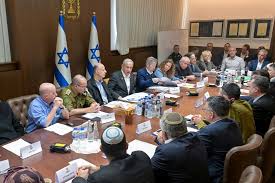
Israel’s Security Cabinet has sanctioned the ceasefire and hostage-release agreement with Hamas, as stated by the Prime Minister’s Office (PMO).
In a communication on X, the PMO indicated that the Security Cabinet has advised the full Cabinet to endorse the agreement, asserting that the proposed arrangement aligns with the objectives of the ongoing conflict.
Following this endorsement, Israel’s Cabinet convened on Friday to deliberate on a ceasefire and hostage release agreement concerning Gaza, which is anticipated to be implemented over the weekend, according to Prime Minister Benjamin Netanyahu’s office.
The accord, previously ratified by the Security Cabinet, aims to cease hostilities and aerial assaults in what has been described as Gaza’s most lethal conflict to date.
Facilitated by Qatar, the United States, and Egypt, the agreement is expected to result in the release of hundreds of Palestinian detainees from Israeli prisons in the coming weeks.
The Justice Ministry has released a list of 95 Palestinians slated for release beginning Sunday, pending government approval.
This list comprises 69 women, 16 men, and 10 minors.
Despite opposition from Netanyahu’s far-right ministers, Bezalel Smotrich and Itamar Ben Gvir, the agreement is likely to receive approval, given their limited influence within the decision-making bodies—holding only two votes in the 11-member Security Cabinet and six votes in the full 36-member Cabinet.
Nevertheless, Smotrich’s threat to withdraw from the ruling coalition and destabilize Netanyahu’s government has reportedly compelled him to acquiesce to the demands of more extreme factions.
The Jerusalem Post has reported that Netanyahu has conceded to Smotrich’s request to terminate the agreement after the initial phase and to recommence military operations in Gaza following the six-week ceasefire. The publication further noted that he has also agreed to Smotrich’s stipulation regarding the regulation and limitation of aid entering Gaza.
If Netanyahu were to violate the agreement after the initial phase, it would likely result in the near-certain deaths of the remaining hostages, as they would either face retribution from Hamas or be casualties of the subsequent Israeli airstrikes.
Earlier in the day, Netanyahu declared that a ceasefire agreement had been reached between Israel and Hamas, along with the release of hostages. He had delayed the announcement until a last-minute crisis, which he attributed to Hamas, was resolved.
The agreement between Israel and Hamas, mediated by Egypt and Qatar with the assistance of the United States, closely resembles the proposal put forth by US President Joe Biden in May 2024.
This three-phase agreement stipulates that the first phase will last for six weeks, during which 33 hostages will be released in exchange for hundreds of Palestinian prisoners currently held in Israel. The second phase will involve the release of all remaining hostages and the withdrawal of Israeli military forces from Gaza. The third phase is anticipated to address the governance and reconstruction of Gaza following the conflict. The initial six weeks will be utilized to negotiate the details of the subsequent phases.