













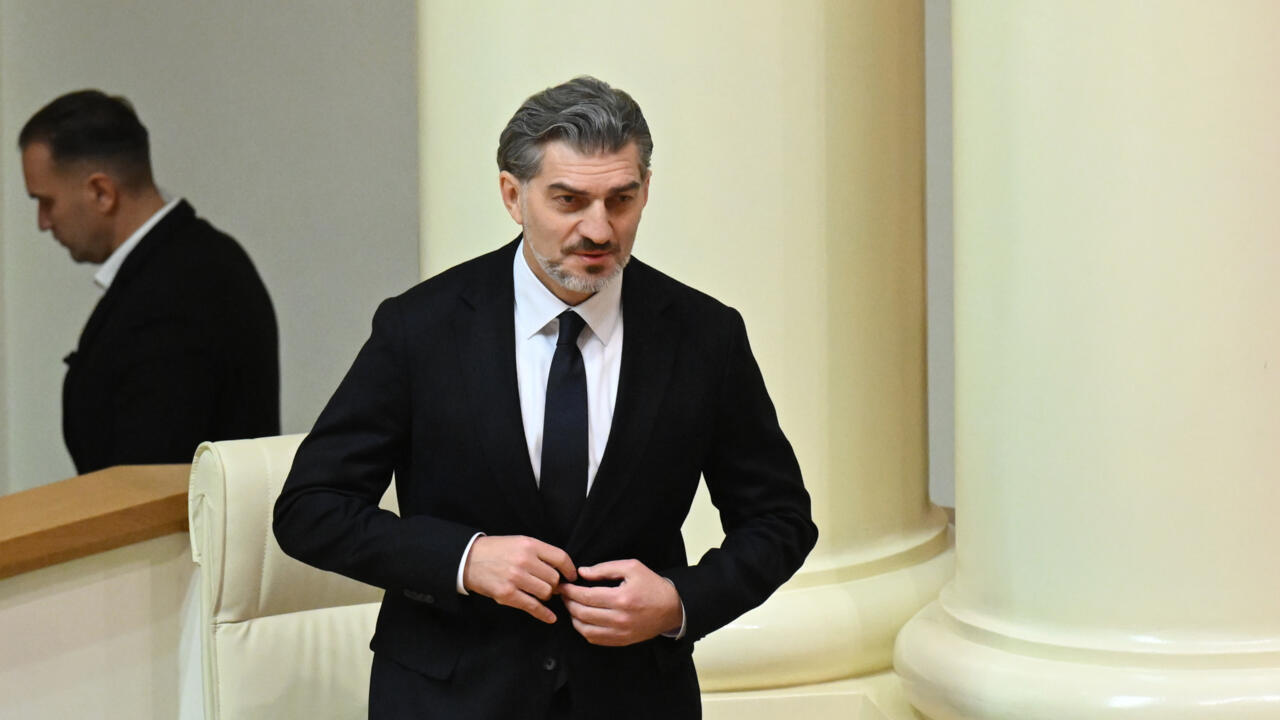
Mikheil Kavelashvili, a staunch critic of Western influence, was inaugurated as the president of Georgia on Sunday amidst a political turmoil following the government’s suspension of discussions regarding European Union membership, a decision that ignited significant protests.
The outgoing President Salome Zourabichvili, a pro-European Union adversary of the ruling party, delivered a resolute address to her supporters outside the presidential palace, asserting her departure from the residence while declaring that Kavelashvili lacked legitimacy as president, a role that is primarily ceremonial.
She stated, “I will come out of here and be with you.”
“I am taking legitimacy with me, I am taking the flag with me, I am taking your trust with me,” she continued, before exiting the palace to engage with her supporters.
Zourabichvili contends that Kavelashvili was not properly elected, as the legislators who appointed him were chosen in an October parliamentary election that she claims was tainted by fraud. Opposition parties in Georgia stand in solidarity with her.
Conversely, the ruling Georgian Dream party and the nation’s election commission assert that the October election was conducted fairly. They maintain that Kavelashvili is the legitimately elected president.
This presidential impasse is viewed as a pivotal moment for Georgia, a mountainous nation of 3.7 million people that had recently been recognized as one of the most democratic and pro-Western among the former Soviet republics.
Kavelashvili is a loyal supporter of Bidzina Ivanishvili, a reclusive billionaire and former prime minister, who is widely regarded as the de facto leader of Georgia.
On Friday, the United States imposed sanctions on Ivanishvili, citing his role in steering Georgia towards an anti-Western and pro-Russian orientation.
Protesters displayed red cards
Kavelashvili, a former professional soccer player who had a brief stint as a striker for Manchester City, has consistently accused Western intelligence agencies of conspiring to lead Georgia into conflict with neighboring Russia.
“The Georgian populace has always recognized that peace is the essential foundation for survival and progress,” he stated following his swearing-in ceremony on Sunday.
Demonstrators outside the parliament held up red cards in a satirical nod to Kavelashvili’s sports career.
The Georgian Dream party secured nearly 54% of the official vote in the elections held in October.
Both local and international election observers have reported that the election was marred by irregularities that may have influenced the outcome. Western nations have called for a thorough investigation.
Zourabichvili is supported by the four principal pro-EU opposition parties in the country, which have been boycotting parliament since the election. They assert that she remains the legitimate president until new elections are conducted.
This confrontation arises during a month of protests triggered by Georgian Dream’s decision to suspend EU accession talks until 2028, abruptly halting a long-standing national objective of joining the bloc, a goal enshrined in the country’s constitution.
This decision has incited widespread discontent among Georgians, who, according to polls, are predominantly pro-EU, and has led to a police crackdown resulting in the detention of over 400 individuals, including prominent opposition leaders.
Zourabichvili has accused Georgian Dream of intentionally undermining Georgia’s EU aspirations and instead aligning the country with Russia, from which Georgia gained independence in 1991.
Supporters of the opposition contend that under Zourabichvili, who was elected with the backing of Georgian Dream in 2018 before parting ways with the party in recent years, the presidency remains the only institution in the nation not ultimately under the influence of ruling party founder Ivanishvili.
They argue that with Kavelashvili’s appointment, Ivanishvili will achieve complete control over Georgia.