


















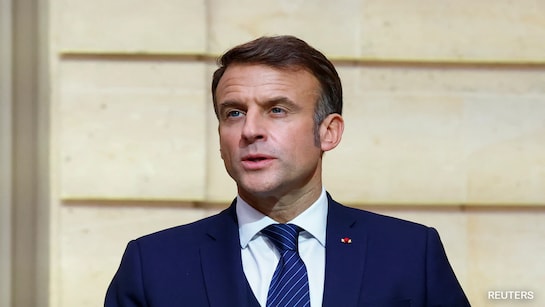
President Emmanuel Macron urged French lawmakers to prioritize the nation’s stability over personal ambitions, warning against a vote that could destabilize the government and plunge the country into chaos.
Marine Le Pen, leader of the far-right National Rally party, has pledged to back a no-confidence motion introduced by a left-wing coalition, which could succeed if both factions unite. Following a June snap election, the National Rally emerged as the largest party in the lower house, elevating Le Pen’s influence in Paris. However, Macron remains optimistic that lawmakers will reconsider their actions.
“The key question for politicians today is how they can serve the country and the French people,” Macron stated to reporters during his visit to Saudi Arabia on Tuesday. “It should not be about advancing their own ambitions or interests.”
In Riyadh, the president criticized the potential support from Le Pen’s party for the no-confidence motion, calling it “a vote of unbearable cynicism,” and expressed disbelief that they would actually endorse it. The debate on the motions is set to begin at 4 p.m. in Paris on Wednesday, with voting to follow shortly after.
Prime Minister Michel Barnier also suggested that the no-confidence motion might not succeed.
“I believe there may be a sense of responsibility among lawmakers,” Barnier said on French television Tuesday. “The higher interests of the country, the common good, and national interest should matter.”
The political turmoil began when Macron called for snap elections after a poor showing in the European elections, resulting in a lower house divided into three opposing factions: a weakened center supporting the president, a leftist coalition, and a strengthened far-right led by Le Pen. Unable to form a coalition, Macron appointed Barnier as prime minister in September, tasking him with stabilizing France’s financial situation.
Barnier employed a constitutional mechanism on Monday to advance a contentious budget bill, prompting the National Rally and the leftist coalition to initiate votes of no confidence. Le Pen proceeded with the motion despite Barnier’s compliance with nearly all of the National Rally’s requests for amendments to the budget legislation.
Should the government fall on Wednesday, it would highlight the influence Le Pen has gained since Macron’s unexpected election call in June. This event would also signify the shortest duration for a prime minister since the establishment of France’s Fifth Republic in 1958. The prevailing political turmoil has led bond investors to penalize France’s sovereign debt in comparison to its counterparts, causing borrowing costs to reach levels comparable to Greece’s at one point last week, prompting Barnier to caution of a potential “storm” in financial markets should he be ousted.
For several months, investors have expressed concerns regarding France’s political instability, coinciding with the government’s efforts to implement measures aimed at reducing its substantial deficit. The budget bill initially proposed by Barnier’s administration included €60 billion ($63.1 billion) in tax hikes and spending reductions, targeting a significant adjustment of the deficit to 5% of economic output by 2025, down from an estimated 6.1% this year. A government collapse so near the year’s end would plunge France into uncharted waters. The outgoing administration, functioning in a caretaker role, could resort to emergency legislation to collect taxes and ensure a minimal level of expenditure, though the economic and financial repercussions remain uncertain.
Antoine Armand, the current finance minister, cautioned earlier on Tuesday that temporary legislation would result in tax increases for millions of households and hinder planned spending boosts for certain priorities, including security and agriculture.
What Occurs If the Government Collapses?
Barnier would submit his resignation as head of the government. His departing cabinet would continue to function with limited authority to oversee ongoing matters. The French president holds the exclusive responsibility for appointing a new prime minister, and there is no constitutional deadline for making this decision. It took Macron nearly two months to choose Barnier, as there was no clear candidate capable of securing a majority in a divided parliament.
The caretaker government is expected to depend on untested emergency legislation to manage tax collection and execute essential spending deemed necessary. Once appointed, the new prime minister would need to propose a cabinet for the president’s approval. Additionally, the new administration would be required to present a budget for 2025 to parliament. A new legislative election cannot occur until July. However, Macron has expressed optimism that the politicians voting on Wednesday will reconsider their positions.
“The primary question for politicians today should be how they can serve the country and the French people,” Macron stated in Riyadh. “It should not be about how they can advance their own ambitions or interests.”
If the government is defeated in a vote, the ministers will retain their positions in a caretaker capacity to manage current affairs, which may include implementing emergency legislation to prevent a shutdown. Ultimately, it will be Macron’s responsibility to appoint a new prime minister, with no constitutional timeframe for this action.
Meanwhile, the president has indicated that he will not resign until the conclusion of his full term. Although the left has urged Macron to step down, he cannot be compelled to leave his position. The next presidential election is scheduled for 2027, with Le Pen currently leading in the polls.
“I have been elected twice by the French people, and I take great pride in that,” Macron remarked. “I will fulfill that trust with all my energy until the very end, to be of service to the country.”