

















New Delhi:
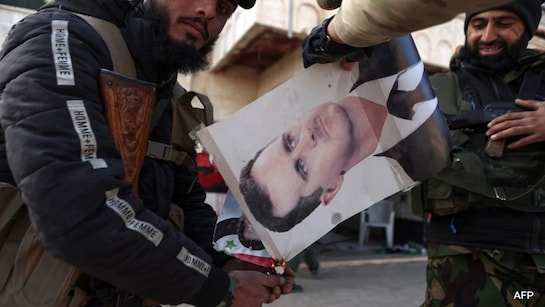
The civil war in Syria has experienced a resurgence of violence after a period of relative calm. Thirteen years into one of the most severe humanitarian crises of the 21st century, renewed hostilities have drawn attention back to a conflict that had largely receded from global news coverage. Syrian rebel factions have initiated a significant offensive in Aleppo, which was once a bustling commercial center, presenting the first substantial challenge to President Bashar al-Assad’s regime in several years and potentially further destabilizing an already volatile Middle East.
The Significance of Aleppo
Located approximately 350 kilometers north of Damascus, Aleppo has been a pivotal battleground throughout the Syrian civil war. Prior to the outbreak of conflict, it was one of Syria’s largest cities, with a population of 2.3 million.
In 2012, rebel forces captured the eastern portion of Aleppo, establishing it as a stronghold against President Assad. However, the dynamics shifted in 2016 when government forces, supported by a relentless Russian air campaign, regained control of the city. The siege of Aleppo became emblematic of the war, characterized by indiscriminate bombings, starvation tactics, and widespread displacement. By reclaiming Aleppo, Assad reinforced his grip on critical regions, aided by Russian and Iranian backing.
The recent rebel offensive has focused on areas surrounding Aleppo and has made advances toward its periphery. Should the rebels succeed in breaching these defenses, it could disrupt Assad’s authority over the war-torn nation and reignite fierce urban combat.
Key Players in the Offensive
The leading force behind this offensive is Hayat Tahrir al-Sham (HTS). Previously linked to the terrorist organization al-Qaida, HTS has undergone a transformation, asserting its commitment to governance and military strategy in territories controlled by the opposition. Despite being classified as a terrorist organization by both the United States and the United Nations, HTS’s leader, Abu Mohammed al-Golani, has endeavored to distance the group from its extremist origins.
HTS’s transformation encompasses initiatives aimed at fostering civilian governance in the regions under its control, alongside limited engagement with religious minorities. Nevertheless, the organization continues to be viewed controversially, facing allegations of harboring extremist factions and permitting militant activities within its jurisdiction. HTS collaborates with various Turkish-backed factions, which operate under the Syrian National Army’s umbrella. These groups have historically maintained a complicated relationship, frequently engaging in conflicts among themselves despite their mutual opposition to the Assad regime.
Objectives of the Rebel Offensive
In a video statement regarding the campaign, rebel military leader Lt. Col. Hassan Abdulghany characterized the operation as a necessary defensive measure. “To repel their attacks against our people, this operation is not merely a choice; it is a duty to protect our community and our land,” he stated, as reported by the New York Times. “It has become evident to all that the regime’s militias and their allies, including Iranian mercenaries, have declared an outright war on the Syrian populace.”
The immediate objectives of the rebels include ceasing airstrikes on civilian populations, reclaiming lost territory, and severing vital supply lines for government forces. Their advancements have been swift, resulting in the capture of several villages, key highway junctions, and military installations in Aleppo province.
The Assad Regime’s Response
Syrian state media has reported significant resistance from government forces, asserting that they have inflicted casualties on rebel fighters. The Syrian military, supported by Russian air power, has conducted extensive airstrikes on areas held by the opposition, including the cities of Idlib and Atareb. Civilian casualties have increased, with rescue organizations such as the White Helmets documenting numerous fatalities.
Iran, a significant ally of Assad, has also incurred losses during the offensive, including the death of a senior commander from Iran’s Revolutionary Guards.
The Assad family, which represents a Shia faction, has historically depended on its partnership with Iran to maintain its grip on power. This alliance has proven particularly advantageous since 2011, when President Assad first confronted an anti-government uprising. Following Syria’s descent into turmoil in 2011, Iran has been alleged to have supplied approximately 80,000 combat personnel to Assad’s forces, while Russia has contributed air support.
Regional Dynamics
The timing of this offensive coincides with Iran and its proxies, such as Hamas and Hezbollah, being engaged in conflicts in other regions. Israel’s military operations against Hezbollah in Lebanon and Hamas in Gaza have stretched their resources thin. Furthermore, Russia’s involvement in the war in Ukraine restricts its ability to offer significant reinforcements in Syria. Turkey, a crucial player in the Syrian conflict, supports various rebel factions participating in the offensive. Meanwhile, Israel continues its airstrikes on Iranian-affiliated targets in Syria, aiming to disrupt arms transfers to Hezbollah, resulting in a precarious situation of overlapping conflicts.
The resurgence of fighting has had catastrophic effects on Syrian civilians, especially in areas controlled by the opposition. The International Rescue Committee estimates that nearly 7,000 families have been displaced in recent times.
Northwestern Syria is home to around 4 million individuals, many of whom have been displaced multiple times throughout the conflict. A significant number reside in overcrowded camps with limited access to essential resources such as food, water, and medical care. The renewed violence poses a threat to exacerbate these dire conditions and could lead to another wave of mass displacement.
Implications for the Assad Regime
Although his regime maintains control over approximately 70 percent of Syrian territory, much of this authority is contingent upon the support of external allies like Russia and Iran.
Furthermore, the potential for renewed hostilities poses a threat of rekindling wider conflicts within Syria. Although the Islamic State has been significantly diminished, it continues to function in the area via sleeper cells. A decline in governmental authority may provide opportunities for these extremist factions to reorganize and enhance their operations.