


















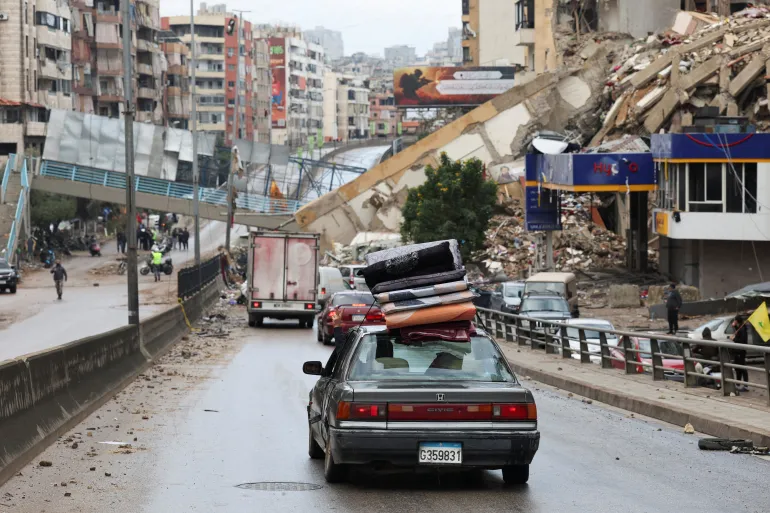
Displaced individuals from Lebanon have begun their return to the southern region of the country, fueled by optimism that the nascent ceasefire agreement between Hezbollah and Israel will be sustained.
Following the announcement of the truce by United States President Joe Biden and French President Emmanuel Macron, civilians commenced their journey southward to their residences shortly after the ceasefire took effect in the early hours of Wednesday. The Lebanese army promptly declared its readiness to deploy to the southern areas affected by the Israeli incursion and to “execute its mission” in accordance with United Nations Resolution 1701.
Central to the ceasefire agreement is the commitment to uphold the 2006 resolution, which mandates Hezbollah’s withdrawal from the border with Israel.
The military has urged residents to refrain from returning to frontline villages until the Israeli forces have withdrawn. Nevertheless, a significant number of civilians are making their way back home.
In a report from the Mediterranean coastal city of Sidon in southern Lebanon, Al Jazeera’s Zeina Khodr noted that with indications of the ceasefire’s stability, thousands of individuals are returning to their homes.
Some individuals were displaying the “victory” sign, as for many, returning home signifies a triumph in itself, she remarked. Nevertheless, it is still uncertain whether all regions will be accessible, as the Israeli army has indicated that its forces continue to operate in certain areas, and evacuation orders remain in effect.
A prevailing sense of relief exists throughout Lebanon, as reported by Khodr; however, the optimism is described as “guarded” due to concerns that the current ceasefire is still quite fragile. Under the terms of the ceasefire, the Lebanese army is expected to deploy south of the Litani River over the next 60 days, in the southern region of the country that shares a border with Israel. Israeli forces will gradually withdraw, and Hezbollah is also expected to retreat from the area.
While there are indications that the ceasefire is being maintained, tensions persist.
The Israeli government, which approved the agreement late on Tuesday, has stressed that it will initiate further attacks if there are any indications that the terms are not being upheld.
On Wednesday, the Israeli military reported that it had “identified a vehicle with several suspects in a zone prohibited for movement in Lebanese territory.”
Israeli forces reported that they had “fired to prevent them from advancing, and the suspects vacated the area.”
In the hours preceding the truce that commenced at 4 am (02:00 GMT), Israel conducted a series of airstrikes on Lebanon, targeting the border crossings with Syria.
The United States, Israel’s primary ally, also carried out a strike on an undisclosed location in Syria, claiming it aimed at a weapons cache belonging to an “Iranian-aligned” militia.
Iran, a supporter of Hezbollah, expressed its approval of the ceasefire on Wednesday. The Iranian foreign ministry conveyed Tehran’s “strong support for the Lebanese government, people, and resistance.”
Attention now shifts to Gaza, where the situation remains dire following Israel’s military operations that began after the Iran-backed Hamas launched an attack on southern Israel in October 2023. Israeli forces continue their offensive against the besieged territory. Reports from Al Jazeera correspondents indicate that several individuals were killed in an attack on the al-Tabin School shelter for displaced persons in Gaza City on Wednesday.
President Biden has indicated his willingness to make “another push” for a ceasefire in Gaza; however, there are limited indications that a swift resolution is forthcoming.
Hamas has yet to officially respond to the agreement regarding Lebanon but has previously stated its readiness for a ceasefire contingent upon the withdrawal of Israeli troops from the enclave, the return of displaced individuals to their homes, and the facilitation of increased humanitarian aid.
Nevertheless, Israel has dismissed these conditions, asserting that the return of the approximately 100 captives still held by Hamas is a prerequisite.