


















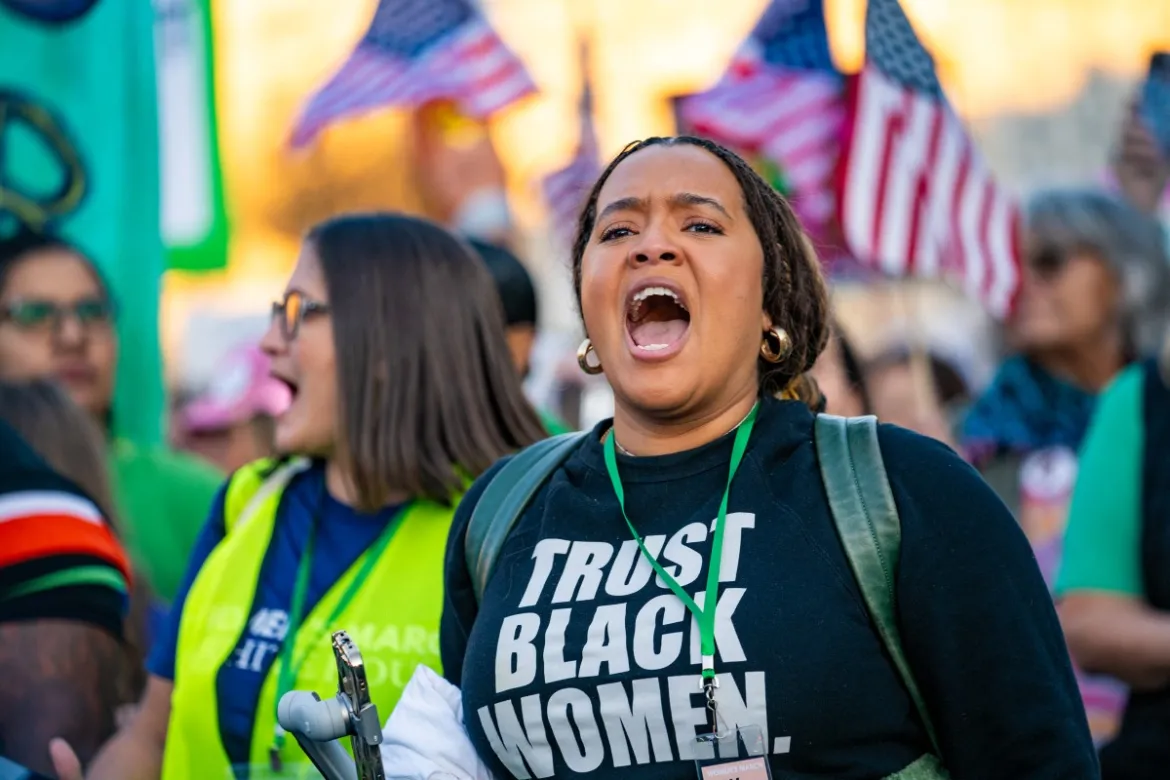
Thousands of women gathered in Washington, DC, to express their support for Democratic presidential candidate Kamala Harris and advocate for reproductive rights.
The vice president has prioritized abortion rights as a key element of her campaign against Republican Donald Trump, who has seemingly endorsed the 2022 Supreme Court decision that revoked the constitutional right to abortion.
“Voting for a candidate who will uphold our rights as women is my top priority,” stated Leah Brooker, 19, who traveled from North Carolina to participate in the event on Saturday, just three days before Election Day.
The student mentioned that she had already voted during the early voting period, describing it as “very empowering that my first vote was for a woman.”
She carried a sign that read: “If boys will be boys, then women will be presidents.”
Other signs featured messages such as “Voting prevents unwanted presidencies” and “A woman’s place is in the Oval Office.”
Organizers estimated that approximately 15,000 individuals attended the rally, with similar events taking place in other cities across the United States.
With the US Capitol dome in the background, speakers at Freedom Plaza energized the crowd in support of the 60-year-old Harris.
“We’re not going back!” the audience chanted, echoing one of Harris’s campaign slogans.
Marlene Wagner, a 70-year-old retiree from Nebraska, expressed her motivation for attending: “I’m here for my grandkids and my children because I fear for their future.”
In her Midwestern state, abortion is prohibited after the 12th week of gestation.
This limitation was implemented following the 2022 decision by US Supreme Court justices appointed by Trump, which resulted in the revocation of the national right to abortion established 50 years earlier by the Roe v. Wade ruling.
Abortion rights are being voted on in ten states, with referendums occurring concurrently with the presidential election.
In Nebraska, one proposal aims to incorporate abortion restrictions into the state constitution, while another seeks to prolong the timeframe during which the procedure is permissible.
For Wagner, who also took part in the inaugural Women’s March in 2017 following Trump’s election, the decision was clear-cut.