

















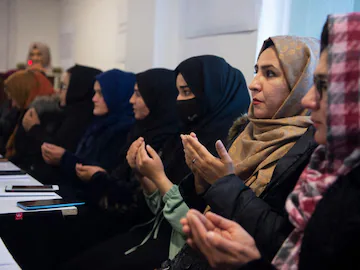
Women in Taliban-controlled Afghanistan have reportedly been prohibited from “hearing each other’s voice” as part of a broader effort to curtail fundamental freedoms. A recent decree specifies that women are not permitted to pray aloud in the presence of one another, according to a report from a Virginia-based Afghan news outlet.
As reported by Amu TV, the directive was issued by Mohammad Khalid Hanafi, the Taliban’s minister for the propagation of virtue and the prevention of vice (PVPV). He indicated that women should refrain from reciting the Quran aloud when in the company of other women.
The report further noted that since women are barred from calling takbir or azaan (the Islamic call to prayer), they are similarly restricted from singing or enjoying music.
A report from The Telegraph highlighted that Hanafi emphasized a woman’s voice is deemed “awrah,” which signifies something that must be hidden, implying it should not be audible in public, even among other women.
Currently, this decree pertains solely to prayers; however, experts express concern regarding its potential broader implications. Women are already prohibited from speaking in public, and even female healthcare professionals—among the limited number of Afghan women permitted to work outside their homes—are not allowed to converse with male relatives.
A midwife in Herat conveyed to Amu TV, “We are not permitted to speak at checkpoints while commuting to work, and in clinics, we are directed to refrain from discussing medical matters with male relatives.”
This directive represents the latest in a series of restrictions placed on women under the Taliban regime, which regained control in 2021. In August, a mandate was established requiring women to wear full-body coverings, including face veils, when in public spaces.
This announcement follows closely on the heels of the Taliban’s recent prohibition on images of living beings. Journalists throughout Afghanistan reported to AFP that the Ministry of Morality is progressively enforcing a ban on the depiction of living entities in the media, with several provinces implementing restrictions and some Taliban officials declining to be photographed or filmed.
Since mid-October, the PVPV has convened meetings with journalists across various provinces, informing them that a ban on capturing and publishing images of living beings—specifically people and animals—will be gradually enforced as part of a new “vice and virtue” law.
During the Taliban’s previous rule from 1996 to 2001, television was entirely prohibited; however, such a ban has not yet been reinstated since their return three years ago. The enforcement of many provisions of the “vice and virtue” law, which outlines the Taliban’s stringent interpretation of Islamic law and encompasses extensive behavioral codes, has been inconsistent.
Nevertheless, journalists have voiced apprehension regarding the potential for a comprehensive crackdown that could render Afghanistan the sole Muslim-majority nation to impose such restrictions.