

















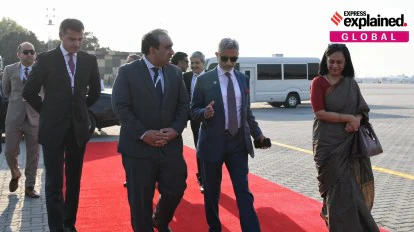
The heads of government meeting of the Shanghai Cooperation Organisation (SCO) took place on Wednesday, October 17, with participation from India, Pakistan, China, Russia, and six additional member nations. External Affairs Minister S. Jaishankar made a significant visit to Islamabad for this meeting, marking the first such trip in nine years.
During the discussions, there were tentative advancements regarding India-Pakistan relations, although India continued to be the sole SCO member that did not support China’s Belt and Road Initiative. Jaishankar also expressed India’s apprehensions concerning China and Pakistan through indirect references.
The member countries of the SCO include India, China, Pakistan, Russia, Iran, Kazakhstan, Kyrgyzstan, Tajikistan, Uzbekistan, and Belarus.
The following are the key takeaways from the meeting:
Cricket back on table for India and Pakistan?
Jaishankar and his Pakistani counterpart, Muhammad Ishaq Dar, who also serves as the Deputy Prime Minister, engaged in two discussions within a span of less than 24 hours. These dialogues suggested that the possibility of reinstating some level of cricketing relations between the two nations was considered. Sources emphasized that these discussions are in the initial stages; however, they present an opportunity, with a potential first step being the Champions Trophy scheduled to be hosted by Pakistan next February.
Jaishankar message to Pakistan, China
In his speech, Jaishankar outlined the primary challenges that the Shanghai Cooperation Organization (SCO) is dedicated to addressing, namely terrorism, separatism, and extremism.
“Reflecting on the evolution from the establishment of the SCO Charter to the present circumstances, it is evident that these objectives and responsibilities have become increasingly vital. In the absence of trust or sufficient cooperation, and where friendship and good neighborliness are lacking, it is imperative to engage in self-reflection and identify underlying issues,” he remarked.
The SCO Charter emphasizes the enhancement of “mutual trust, friendship, and good neighborliness among member States” as well as the imperative of “combating terrorism, separatism, and extremism.”
In a pointed remark regarding Pakistan, Jaishankar stated, “When cross-border activities are marked by terrorism, extremism, and separatism, they are unlikely to foster trade, energy exchanges, connectivity, and interpersonal interactions simultaneously.”
In what is interpreted as a reference to China’s Belt and Road Initiative (BRI), he asserted, “Cooperation must be founded on mutual respect and sovereign equality. It should uphold territorial integrity and sovereignty. Genuine partnerships, rather than unilateral agendas, are essential for progress. We cannot advance if we selectively adopt global practices, particularly in trade and transit.”
The Belt and Road Initiative
China’s President Xi Jinping introduced the ‘Belt’ initiative during his visit to Kazakhstan in 2013. The objective of the ‘Belt’ plan was to rejuvenate a network of trade and infrastructure routes linking Asia and Europe, with a significant emphasis on enhancing connectivity through Central Asia. Following this, Xi unveiled a maritime component known as the ‘Road’, designed to connect China with Southeast Asia, Europe, and Africa. The primary focus of this initiative has been the construction of ports, bridges, industrial corridors, and other essential infrastructure across Southeast Asia and the Indian Ocean.
India has consistently opposed the Belt and Road Initiative (BRI), citing concerns over territorial integrity and sovereignty, particularly as it traverses through Pakistan-occupied Kashmir. New Delhi has also warned that nations participating in BRI projects may risk succumbing to China’s debt dependency.
Conversely, Pakistan has expressed strong support for the BRI, particularly through the China-Pakistan Economic Corridor (CPEC), which promises substantial infrastructure advancements within the country.
During the recent meeting, Pakistan’s Prime Minister Shehbaz Sharif emphasized that the project should not be viewed through a “narrow political prism.” He stated, “Let us not look at such projects through the narrow political prism, and invest in our collective connectivity capacities which are crucial to advancing the shared vision of an economically integrated region.”
Chinese Premier Li Qiang, while refraining from directly mentioning the BRI, remarked, “We should continue to draw impetus from openness and cooperation, boost the region’s trade and investment facilitation and connectivity, and maintain stable and smooth industrial and supply chains.”
According to the Pakistani newspaper Dawn, a joint communique issued at the conclusion of the SCO meeting reaffirmed support for the People’s Republic of China’s One Belt, One Road (OBOR) initiative and acknowledged ongoing efforts for the joint implementation of the project.
India, however, did not endorse this communique.
Sanctions, trade protectionism raised
The recent SCO meeting highlighted concerns regarding the “unilateral sanctions” imposed by Western nations on countries such as Russia and Iran.
According to the communique reported by Dawn, “the heads of delegations underscored that the unilateral imposition of sanctions contradicts the principles of international law and adversely affects third countries as well as international economic relations.”
Sanctions targeting Iran and China hinder the ability of smaller, economically vulnerable nations to engage in trade with them, as these nations fear repercussions from the United States and other Western countries. Pakistan serves as a notable example of this situation.
China has expressed discontent over the elevated tariffs imposed by countries like the United States and Canada on its products, although it has retaliated with its own increases in tariffs.